
Lancôme
La Nuit Trésor Rouge Drama
La Nuit Trésor Rouge Drama: Hyperbole as a creative principle. There exist in the history of perfumery two diametrically opposed schools: that of elegant restraint, which cultivates understatement and prefers to murmur rather than declaim, and that of unabashed exuberance, which embraces overstatement, claims excess, and celebrates extravagance as an aesthetic principle. La Nuit Trésor Rouge Drama, launched by Lancôme in December 2025, belongs resolutely to this second category. From its name onward, the fragrance displays its intention without ambiguity: this will not be a timid romance nor a sensible love, but a passionate drama worthy of a theatrical tragedy, with its share of madness, excess and absoluteness.
Where to buy
Because the word drama does not here mean something negative or conflictual—this is not about social media drama or daily quarrels. It refers instead to drama in the theatrical and artistic sense of the term: that emotional intensity that makes hearts race in darkened theaters, those Shakespearean passions that devour the protagonists, that love-as-passion in the manner of Tristan and Isolde which knows neither reason nor moderation. Lancôme fully embraces this hyperbolic dimension by multiplying superlatives in its communication: our most delicious fragrance, the most intense in the collection, love in its deepest depths and its most impressive heights. This accumulation of grandiose phrasing could verge on the ridiculous were it not carried with such conviction, borne by a juice that indeed delivers on its promises of sensory intensity.
The red of the Louvre's Red Rooms: a color charged with history
The official inspiration for Rouge Drama draws from a very specific and highly symbolic place: the Red Rooms of the Louvre Museum. These spectacular spaces, covered in crimson velvet from floor to ceiling, house the collections of Italian and Spanish paintings—Titian, Veronese, Caravaggio, Velázquez. This radical chromatic choice, which might seem excessive in any other context, finds its justification here in the history of museography: in the nineteenth century, dark red was considered the ideal color for showcasing the gold of frames and the colors of master paintings, creating a dramatic contrast that magnifies the exhibited works.
By drawing inspiration from these Red Rooms, Lancôme does not merely borrow a shade: the house summons an entire cultural imagination. The red of the Louvre is that of royalty and power (think of palace hangings, ceremonial carpets, the velvet of thrones), but also that of passion and blood (think of the drapery in religious paintings depicting the martyrdom of saints, the scarlet cloaks of biblical figures). It is a red that does not fear grandiloquence, that embraces its emotional and historical weight, that refuses discretion in favor of theatrical assertion.
Drama versus dramatic: the lexical nuance that changes everything
Lancôme uses the English word drama rather than the French word drame, and this linguistic nuance is worth dwelling on. In French, dramatique often carries a negative connotation—one speaks of a dramatic situation to evoke something serious, tragic, potentially catastrophic. Drama in contemporary English usage, by contrast (especially in pop culture and social media vocabulary), refers more to emotional intensity, spectacle, and self-aware exaggeration without necessarily any tragic connotation.
This dimension of drama as amplified emotional performance is found particularly in the world of fashion and makeup: one speaks of dramatic eyes for an intense smoky look, of a drama queen for someone who theatricalizes their emotions, of bringing the drama to describe a spectacular, self-assured attitude. La Nuit Trésor Rouge Drama fits into this aesthetic of proclaimed emotional excess: it is not about living through a tragedy but about living love as a theatrical scene where every emotion is amplified, magnified, carried to its expressive peak.
A decade of desire: the evolution of a gourmand-aphrodisiac lineage
To fully understand Rouge Drama, one must first return to the genesis of La Nuit Trésor, the original fragrance launched in 2015 that inaugurated a new era for Lancôme. This creation, signed by the duo Christophe Raynaud and Amandine Clerc-Marie, was presented as the first gourmand aphrodisiac in the history of perfumery—a bold marketing formula that announced the ambition of reconciling sweet gourmand character and erotic sensuality, two registers that classical perfumery generally kept separate.
2015: the original La Nuit Trésor, a love potion in black diamond
The original La Nuit Trésor offered a composition radically different from its predecessor Trésor (1990), that sophisticated aldehydic floral that smelled of bourgeois elegance and bridal bouquets. Out went classical restraint, in came gourmand exuberance: black rose, Tahitian vanilla orchid, praline lychee, incense, papyrus, patchouli. The pyramid multiplied exotic and precious ingredients, creating a heady sillage that strongly divided opinion—some found it irresistibly sensual while others denounced a nauseating caramelized heaviness.
The faceted black diamond-shaped bottle, adorned with a black satin rose and a bow, unapologetically displayed its ostentatious luxury. Penélope Cruz, face of the campaign photographed by Mert Alas and Marcus Piggott, embodied that passionate, dramatic femininity the fragrance aimed for. Commercial success was immediate despite (or thanks to) the polarized reception: La Nuit Trésor established itself as the fragrance for women unafraid of doing too much, who embraced frontal rather than suggestive seduction.
The multiplication of fruity flankers: from redcurrant to cherry
Buoyed by this success, Lancôme went on to release La Nuit Trésor in multiple versions systematically exploring red fruits. À La Folie (2017) introduced redcurrant in a tart-fruity register. Caresse (2018) paired raspberry and lychee for a velvety sweetness. Intense introduced black cherry in a more heady version. Le Parfum (2024), the most concentrated version in the range, worked blackcurrant with bitter cocoa, creating a more adult, less overtly gourmand sophistication.
This obsession with red fruits is obviously not incidental. In collective imagination and universal symbolism, red fruits carry a particular erotic charge: the plump shape of the strawberry evokes full lips and the kiss, the cherry traditionally symbolizes lost virginity (think of the expression losing one's cherry), raspberry and redcurrant suggest an acidity that awakens the senses. These fruits also possess an immediately identifiable visual quality—their bright red color draws the eye, creates a striking contrast with the black of the bottle, and visually announces the gourmand character of the juice.
Rouge Drama 2026: strawberry as the climax of the fruity series
With Rouge Drama, Lancôme in a sense closes the cycle of red fruits by choosing strawberry—perhaps the most emblematic and universally loved of all these fruits. But unlike previous versions that used synthetically reconstructed fruity accords, Rouge Drama relies on a natural strawberry extract, joining the pursuit of authenticity inaugurated by Idôle Peach N' Roses with its Peach Orpur™. This claimed naturalness reflects a broader evolution in contemporary perfumery, which seeks to escape accusations of being chemical or artificial by foregrounding its natural ingredients—even if, ironically, the overall composition remains predominantly synthetic. This natural strawberry constitutes the differentiating argument that justifies the premium price positioning and distinguishes Rouge Drama from the mass of strawberry-rose fragrances saturating the market.
Anatomy of a ruby bouquet: an olfactory dissection act by act
The composition of La Nuit Trésor Rouge Drama unfolds around three distinct movements progressing from tart fruit to an opulent floral heart, finally anchoring in a woody-vanilla base. This classic three-part structure is here handled with particular attention to transitions and layering, creating less a linear succession of notes than a progressive sedimentation where each new layer enriches the previous ones without fully erasing them.
Act I: the jubilant acidity of lemony strawberry
Rouge Drama opens on an explosion of natural strawberry possessing that tart-juicy quality of perfectly ripe strawberries picked in the garden. This natural extract differs radically from synthetic reconstructions (often based on molecules such as furaneol or methyl anthranilate) which tend to produce an overly sweet, one-dimensional strawberry that smells more of candy or industrial jam than fresh fruit. Here, the strawberry retains all its nuances: the green acidity of a not-quite-ripe strawberry, the watery juiciness of the flesh, that almost floral scent rising from the crushed fruit, and even a slightly wine-like facet reminiscent of strawberries macerated in sugar.
This natural strawberry is immediately joined by citrus—lemon zest and bergamot—which amplify its vivacity while creating an essential citrus freshness. Without these citrus notes, the strawberry would risk seeming too heavy, too jam-like from the opening. Lemon brings its characteristic citrusy sharpness, that almost metallic note that makes the mouth water and awakens the olfactory senses. Bergamot, a more sophisticated and complex citrus than plain lemon, adds bitter-floral facets that already foreshadow the rose bouquet to come. This fruity-tart opening lasts a relatively short time—fifteen to twenty minutes at most—creating a sparkling prologue that captures attention before the real floral drama begins.
Act II - Scene 1: the quartet of roses, an orchestrated plurality
It is in the heart that Rouge Drama reveals its true richness and complexity. Unlike fragrances content with a single type of rose (usually Damask rose or May rose), Lancôme here composes a genuinely polyphonic bouquet by pairing red rose with Damask rose. This duality is not merely a marketing device: the two roses possess noticeably different olfactory profiles which, layered together, create a depth and texture impossible to achieve with a single variety.
Damask rose (Rosa damascena), cultivated mainly in Bulgaria and Turkey, has for centuries constituted the reference standard in perfumery. Its absolute—obtained by extraction from rose concrete—has an intense, rich, almost heady scent, with honeyed and slightly spicy facets. It is the rose of the great classic fragrances, the one that smells rich and precious, the one requiring thousands of petals to produce a few grams of absolute. In Rouge Drama, this damascena rose brings depth, body, that velvety quality that wraps the juice in an almost tactile sensuality.
The red rose mentioned separately in the pyramid probably refers to an accord created specifically to evoke the color as much as the scent—an idealized rose that smells of vermillion red, deep ruby, the crimson velvet of the Louvre's Red Rooms. This red rose likely possesses a more fruity, more raspberry-like facet (the rose ketone molecules that give roses their characteristic scent naturally contain notes reminiscent of raspberry), creating an olfactory bridge between the opening strawberry and the more classic Damask rose.
Act II - Scene 2: powdery violet and creamy ylang-ylang
But the floral heart is not limited to roses: violet and ylang-ylang enrich the bouquet with complementary facets. Violet brings that characteristic powdery-sweet quality, an almost velvety texture evoking the pansy petal or the violet lozenges of our grandmothers. In perfumery, violet (generally recreated via synthetic ionones rather than extracted from the flower, which gives a negligible yield) also possesses a slightly green, almost cucumber-like dimension that freshens the opulence of the roses and keeps the heart from tipping into nauseating floral heaviness.
Ylang-ylang (Cananga odorata), a flower from the Comoros distilled to produce one of the most sensual essences in the perfumer's palette, adds its characteristic tropical creaminess. This flower has an extraordinarily rich and complex scent that simultaneously evokes ripe banana, coconut, jasmine, and a slightly medicinal-balsamic undertone. In high concentrations, ylang-ylang can become heady, almost narcotic—it is indeed one of the favorite flowers of sensual oriental perfumery. Here, dosed with precision, it brings an exotic creaminess that enriches the roses without overpowering them, creating that impression of an opulent, multifaceted bouquet that reveals itself progressively on skin.
Act III: the woody-vanilla foundation, anchoring in sensuality
The base of La Nuit Trésor Rouge Drama gradually abandons the fruity-floral freshness of the opening and heart to settle into a resolutely warmer, deeper, more animalic register. Three pillars support this base architecture: velvet wood, patchouli and vanilla. This trilogy creates a comforting, sensual foundation that completely transforms the character of the fragrance: one moves from fruity frivolity to an almost carnal gravity.
Velvet wood—a poetic name that probably designates a synthetic woody accord rather than a specific natural essence—evokes qualities both soft and structured, of wood worked, polished, caressed. It brings to mind sandalwood in its creamy-milky version, or perhaps certain modern woody musks (such as Ambrofix or Cashmeran) that create this impression of velvety softness. This wood does not smell of sawdust or damp forest: it evokes instead the antique furniture patinated by time, the precious wood jewelry box, those domestic objects charged with intimacy and quiet sensuality.
Patchouli (Pogostemon cablin), an essential oil obtained by distilling the dried leaves of this plant native to Southeast Asia, brings its characteristic earthy depth. Patchouli has an extraordinarily tenacious scent—it is one of the most persistent ingredients in the entire perfumer's palette—which smells simultaneously of damp undergrowth, aged leather, dark chocolate, and even possesses almost wine-like facets. Long associated with oriental fragrances and the hippie scents of the 1970s, patchouli has enjoyed a resurgence in favor over recent decades in modern feminine perfumery, which appreciates its ability to add gravity and depth to compositions that might otherwise remain too light or too sweet.
Vanilla, the final pillar of this gourmand base, wraps the whole in a creamy sweetness that softens the potentially rough edges of the patchouli. But this vanilla does not smell of cake or pastry cream: worked in combination with the patchouli and woods, it instead develops a leather-vanilla facet, almost animalic, closer to birch-scented Russian leather than to Mexican vanilla pod. This vanilla has what perfumers sometimes call a dirty or anisic quality—not in a pejorative sense but in the sense of a vanilla that retains its least polished, least sweetened facets, those that give it character and personality rather than simple conventional sweetness.
The diamond dressed in purple: the visual metamorphosis of an icon
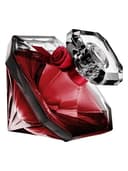
Since the original La Nuit Trésor in 2015, the faceted diamond-shaped bottle has become the immovable visual identity of the entire line. This bold geometric silhouette, which breaks with the rounded, feminine codes of most women's fragrances, simultaneously evokes several cultural references: the diamond as a symbol of luxury and preciousness, the jewel as a metaphor for precious love, the crystalline form as an evocation of mineral purity. Every new flanker in the range has retained this recognizable silhouette while playing on chromatic variations and ornamentation to create its own visual identity.
From black to red: chromatic symbolism and the language of colors
The original La Nuit Trésor bore a deep, absolute black, evoking the black diamond mentioned in the marketing narrative—a gem born from the collision of two stars. This black visually conveyed mystery, night, secrecy, that dark, almost gothic dimension of passionate love. Successive flankers then explored different chromatic variations: pink for Caresse, cherry red for Intense, ruby black for Le Parfum...
With Rouge Drama, Lancôme pushes chromatic intensity to its peak: the bottle takes on a deep ruby red, almost blood-colored, which radiates that color from within as though the juice itself illuminated the glass. This red is neither the bright, cheerful red of Coca-Cola advertising, nor the orange-red of sunsets: it is a dark, dense, saturated red that evokes simultaneously the velvet of the Louvre's Red Rooms, the ruby set in an engagement ring, Burgundy wine in a crystal glass, the stage curtain of an Italian-style theater.
This red color carries an overwhelming symbolic weight in the Western collective unconscious. Red of blood that flows through veins and makes the heart beat—red of organic life, of bodily warmth, of physiological excitement. Red of romantic passion and erotic desire—red of full lips, painted nails, crumpled satin sheets. Red of power and royalty—red of ceremonial carpets, cardinals' cloaks, the wax seals that authenticate official documents. Red of danger and the forbidden—red of alarm signals, restricted zones, everything one should not touch but desires precisely because it is forbidden.
The satin rose: textile ornament and tactile metaphor
All La Nuit Trésor bottles are adorned with a fabric rose—generally in satin—that crowns the glass diamond and creates a fascinating contrast between the mineral hardness of the bottle and the textile softness of the ornament. For Rouge Drama, this textile rose naturally takes on the same ruby tones as the bottle, creating a most attractive gradient of reds. But beyond its decorative function, this fabric rose fulfills several semiotic and sensory roles.
First, it creates a metaphorical link between content and container: the textile rose visually announces the bouquet of roses that forms the olfactory heart of the fragrance. Second, it introduces an essential tactile dimension: where the smooth, cold glass of the bottle can seem distant and untouchable, the soft satin of the rose invites caress and touch, creating a multisensory experience that goes beyond mere sight. Finally, this textile rose evokes the world of fashion and haute couture—the satin roses pinned onto evening gowns, the textile ornaments adorning great couturiers' creations, that fashion-luxury dimension that Lancôme cultivates throughout its communication.
The black bow: the last vestige of the original black diamond
Beneath the red rose, the bottle retains its black satin bow—the last visual link to the original all-black La Nuit Trésor. This bow serves several functions: it creates an essential chromatic contrast that prevents the red from becoming monolithic and monotonous, it evokes the world of the precious gift (the bow one carefully unties to discover the present), and it maintains a certain classic elegance that tempers the exuberance of the ruby red. Without this black bow, Rouge Drama might tip into kitsch or too-muchness; with it, the bottle retains a sophistication rooted in the house's history.
Women of every drama: mapping a passionate clientele
Who is La Nuit Trésor Rouge Drama for? In its communication, Lancôme paints the portrait of a woman who dares to explore the most intense depths of love, who is ready to live love in its deepest depths and its most impressive heights, who seeks to transform fleeting moments into unforgettable memories. This hyperbolic rhetoric might seem hollow were it not resonant with a sociological reality: there indeed exists an audience for statement fragrances, for scents that do not murmur but proclaim, for juices that turn the simple act of applying perfume into a theatrical gesture.
The lover of sensual gourmands: between sweetness and intensity
The first consumer profile targeted by Rouge Drama is obviously the fan of gourmand-fruity fragrances who is not afraid of projection or longevity. This woman probably already collects several fragrances from the La Nuit Trésor family or other heady gourmands on the market—think of La Vie Est Belle (also from Lancôme), Black Opium by Yves Saint Laurent, Good Girl by Carolina Herrera, Scandal by Jean Paul Gaultier. She appreciates that her fragrance gets noticed, that it leaves a memorable sillage in her wake, that it prompts compliments and questions from those around her.
This consumer is generally between 25 and 45 years old, though the range can of course be broader. She does not necessarily belong to the highest socio-professional categories—unlike customers of ultra-exclusive niche fragrances that cost €200 for 50 ml, she seeks an accessible luxury, a sophistication within reach. Rouge Drama, with its premium designer price positioning (around €80–100 for 50 ml depending on the retailer), sits in this intermediate zone: expensive enough to constitute a meaningful indulgence purchase, not expensive enough to be reserved for an elite.
The unabashed romantic: praise of emotional pathos
Beyond simple taste for gourmands, Rouge Drama also targets women who cultivate a form of heightened romanticism that our cynical, detached era often tends to mock. These are women who still love romantic comedies without irony, who cry watching Titanic even after seeing it ten times, who celebrate Valentine's Day with enthusiasm rather than dismiss it as a commercial holiday, who still believe in grand passions and love at first sight. This romantic sensibility has nothing to do with a lack of intelligence or sophistication: it is a conscious choice to cultivate emotion, to value feeling, to refuse the jaded disenchantment that a certain modernity cultivates.
For these women, wearing Rouge Drama is almost an act of defiance: asserting that it is still possible in 2026 to believe in great feelings, to live love as an absolute adventure rather than as a mere practical arrangement, to prefer tumultuous passion to lukewarm tranquility. The fragrance then becomes an olfactory manifesto, a declaration of intent announcing: yes, I am the one who still believes in happy endings, in kisses in the rain, in fervent declarations of love—and I embrace it fully.
Fitting occasions and ideal wearing situations
La Nuit Trésor Rouge Drama is definitely not an all-purpose fragrance to spray mechanically every morning before heading to the office. It is a fragrance of intention, of celebration, of special moments one wants to mark with a memorable olfactory imprint. The ideal occasions? Romantic dates, of course—a first date where one wants to make an impression, a couple's anniversary evening, a reunion after a separation, all those moments where the emotional stakes justify the intensity of the fragrance.
But also festive evenings among friends when one wants to feel beautiful, desirable, noticed—that evening when one wears the red dress rarely dared, when makeup is bolder than usual, when one brings out one's finest jewelry. Rouge Drama accompanies these moments of self-staging, when one consciously plays a more glamorous role than one's everyday personality, when one indulges in the luxury of being an amplified version of oneself.
Seasonally, Rouge Drama belongs resolutely to the colder months. Its gourmand-woody intensity, its heady floral richness, its assertive projection make it an autumn and winter fragrance. One imagines it worn in November as the days shorten and night falls early, in December during the year-end holidays when red is everywhere (decorated trees, gift wrap, evening attire), in January and February when the cold calls for cocoon fragrances that warm and comfort. Summer and its stifling heat are definitely not the ideal playground for such a fragrance—the strawberry and roses would risk turning cloying, the patchouli and vanilla would become oppressive.
Performance in terms of sillage and longevity logically sits at the high end of what contemporary designer perfumery offers. Rouge Drama projects generously during the first three hours—within a radius of two to three meters, the fragrance will be perceptible and recognizable. This robust projection then gradually diminishes but the fragrance remains detectable at arm's length for another four to five hours. Total longevity on skin easily reaches 10 to 12 hours, or even more on clothing, where the patchouli and vanilla can persist until the next day.
An unabashedly intense fragrance, La Nuit Trésor Rouge Drama is not for timid souls or discreet noses. By pairing the jubilant acidity of natural strawberry with the opulence of a fourfold rose bouquet (damascena, red rose, violet, ylang-ylang), then anchoring this floral-fruity exuberance on a woody-vanilla base of almost carnal depth, Amandine Clerc-Marie and Honorine Blanc compose the olfactory manifesto of a femininity that refuses half-measures. Inspired by the Louvre's Red Rooms, where crimson velvet magnifies masterpieces of painting, Rouge Drama transposes into fragrance this self-assured theatricality, this love of spectacle and amplified emotion that sometimes makes one prefer hyperbole to understatement, passionate declamation to restrained murmur. In a market saturated with fragrances that all seek to please without ruffling, to seduce without disturbing, to exist without making waves, La Nuit Trésor Rouge Drama dares to overflow, claims excess, celebrates extravagance as an aesthetic principle—and demonstrates that overstatement, when carried with conviction and backed by impeccable technical craftsmanship, can become a form of olfactory nobility, a baroque grandeur unashamed of its red velvet folds or its rose petals spilling beyond the frame.
Olfactory pyramid
- Top notesThe first minutes
- Heart notesThe heart of the perfume
- Base notesWhat lingers
Share your impressions
Create an account to keep your votes and find your notebook.