
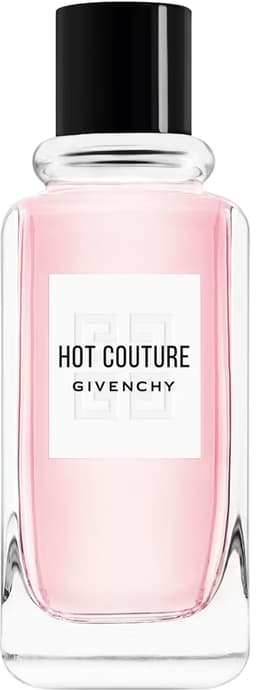
Hot Couture elevates women like a haute couture dress. The house of Givenchy was founded in 1952 by Hubert de Givenchy. Casual chic, romantic, aristocratic, the Givenchy style is timeless and has adapted to different eras
In 2000, the house of Givenchy sought to innovate and mark the new millennium. With this in mind, it envisioned Hot Couture, a floral and sensual fragrance worn the way one wears a haute couture dress. Refined and elegant, Hot Couture is a dreamlike essence, an elixir of sensuality. The Givenchy woman is both glamorous and bold. Charismatic, she loves to seduce. Like an object of pleasure, Hot Couture was designed so that the nectar applies quite naturally to women's skin, mirroring Givenchy's haute couture dresses.
Two talented men behind the sensual feminine elixir Hot Couture
To create this extraordinary fragrance, Givenchy called upon Alberto Morillas and Jacques Cavallier. While they share talent, Alberto Morillas is self-taught. He learned perfumery and chemistry on his own, through contact with other perfumers. Visionary and avant-garde, Alberto Morillas was born in Seville (Spain). In 2003, he received the Coty Award for Best Perfumer, rewarding all his efforts. Alberto Morillas is responsible for magnificent perfumes such as Mademoiselle Ricci by Nina Ricci, Flower by Kenzo by Kenzo, and Belle d'Opium by Yves Saint Laurent. Jacques Cavallier was born in Grasse, to a perfumer father and grandfather. Since 2012, Jacques Cavallier-Belletrud has been the official perfumer of the Louis Vuitton brand. Sensitive and remarkably creative, Jacques Cavallier is behind Cinéma by Yves Saint Laurent, Ange ou Démon by Givenchy, and Fuel for Life pour Lui by Diesel.
Hot Couture, the bold pairing of magnolia and vetiver
Hot Couture opens with the sparkling notes of raspberry, paired with the freshness of orange and bergamot. Native to the mountainous regions of Western Europe, raspberry was highly prized by the Gods of Mount Olympus. The first red raspberries were cultivated in the Middle Ages. It was then, during the Renaissance, that French gardens came to feature raspberry bushes. In France, raspberry has been enjoyed since the 19th century. In perfumery, raspberry is reproduced identically through a synthetic compound. It gives off fruity, sweet and juicy tonalities. Then, the heart of Hot Couture is the unexpected pairing of magnolia and vetiver, an ingredient mainly used in masculine compositions. The whole is heightened by the spicy tonality of pepper. In 1711, the Saint-Michel docked at the quays of Paimboeuf (Loire Atlantique), carrying magnolia shrubs. The name Magnolia Grandiflora had been given in 1703 to a tree discovered in a forest in the Antilles. In the language of flowers, magnolia symbolizes fidelity. In perfumery, magnolia gives off delicate, floral, lemony and slightly vanilla-like scents. Finally, the base is both woody and amber, combining sandalwood, white musks and ambergris. The precious nectar is enclosed in a slender bottle whose shape evokes a feminine silhouette. Its transparency reveals the fleshy pink color of the composition.