
Chanel
Coco
The perfume for women Coco by Chanel It was in 1984 that the house of Chanel decided to call on the talented perfumer Jacques Polge in order to pay tribute to its founder. To do so, the house created a perfume named Coco. It was very quickly described as a baroque perfume and its intoxicating notes seemed ideally designed to leave no one indifferent. This fragrance is at once voracious, mysterious and bewitching. It is a myth of perfumery filled with luxury and refinement, just as the iconic Gabrielle Chanel herself was.
Where to buy
Chanel's tribute perfume
Coco is a nickname that refers directly to Gabrielle Chanel. In reality, this nickname was given to her in the early 1900s when she was still very little known. She used to perform in café-concerts and sang a song called “Qui qu’à vu Coco?”. It tells the story of a lost dog and was without question the most famous song in her repertoire. This is how Coco Chanel came to bear the nickname that never left her. Thus, what better way to pay tribute to this extraordinary designer than by reclaiming this name. Moreover, the name Coco had already been considered by Gabrielle Chanel herself for the perfume N°19, created in 1970. However, it was abandoned because she feared it would not mean much to most of the public and would instead evoke the word rococo or, worse still, cocaine. Nevertheless, this was done 14 years later and this fragrance was a huge success! This perfume manages to blend the refinement and extravagance of Gabrielle Chanel. What is more, it is directly inspired by her apartment and carries within it a certain baroque culture. Thus, it is at once spicy and sweet, voluptuous and contrasted.
The baroque scent of Coco
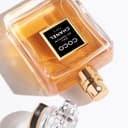
To create this perfume, Jacques Polge drew inspiration from Gabrielle Chanel's apartments, in which exotic accessories, more modern geometric volumes, warm materials, dense and opaque blacks, and exuberant golds intermingled. This is how he crafted a highly contrasted perfume. It pairs the luminosity of orange blossom from the Comoros with frangipani. Peach, for its part, brings a more velvety facet. The whole is also brightened by blackcurrant buds from the Moluccas, while jasmine from India appears more opulent. Two varieties of rose then establish the romanticism and femininity of the whole. Coco contains Bulgarian rose and Turkish rose. The whole is thus very sensual and ends in greater sweetness through a blend of Siam benzoin, tonka bean, Mysore sandalwood and opoponax. Coco comes in a bottle similar to that of N°5, a kind of glass rectangle with slightly beveled edges and topped with a stopper cut like an emerald. Finally, the whole is further adorned with a black and gold label evoking the rich décor of Gabrielle Chanel's apartments.
Olfactory pyramid
- Top notesThe first minutes
- Heart notesThe heart of the perfume
- Base notesWhat lingers
What the community says
Season
Occasion
The community finds it similar to…
- Opium Eau de Toilette — Yves Saint Laurent1 vote
Create an account to keep your votes and find your notebook.
The advertising
A gilded cage at Place Vendôme
In 1991, Vanessa Paradis swings like a bird in a gilded cage for the film by Jean-Paul Goude, set to Stormy Weather by Harold Arlen.
The film L'Esprit de Chanel, also known as L'Oiseau de paradis, was presented in France on October 14, 1991, under the slogan “Coco, l'esprit de Chanel.” Jean-Paul Goude directed it for the agency D'Arcy Masius Benton & Bowles, with production by Pac.
Vanessa Paradis, eighteen years old, plays Coco Chanel's canary: she swings in a gilded cage, on a stormy evening, in a setting evoking a suite at the Ritz on Place Vendôme, under the gaze of a white Angora cat, and whistles the standard Stormy Weather. The English-language version shows her covered in black feathers, as a bird on a swing. Filming began on December 15, 1990 in a hangar built by Eiffel, at the Villacoublay air base near Paris, with miniaturization effects and a reconstruction of Place Vendôme. The film was broadcast about sixty times over a little more than a month before its international release.
On its official channel, CHANEL dates the film to 1991, attributes it to Jean-Paul Goude and credits the music to Harold Arlen for Stormy Weather. Having become the global face of the perfume, Vanessa Paradis notably succeeded Inès de La Fressange.