
Guerlain
Samsara
Samsara: A fragrance of eternal orientalism... Samsara appeared at the end of the 1980s, a decade far more accustomed to heady fragrances than to serene oriental compositions like Jean-Paul Guerlain's creation.
Where to buy
Revolutionary in its fragrance as much as in its advertising campaign, it pays tribute to the scents of Asia. Samsara, the mysterious oriental, won over many women who became devotees of zen and its scents from afar.
Samsara, as much a fragrance as a magnificent story...
In 1989, the illustrious members of the Guerlain family were beginning to lose some of their sway over the house, and it was notably through a fortunate coincidence that Jean-Paul Guerlain's composition was chosen for Samsara. It was the first time a Guerlain creator had been put in competition with other talents within his own house, a sign of changing times...
Regardless, the lovely Samsara would benefit from an advertising halo unmatched by any previous launch. While there was not yet talk of a face of the campaign, the advertising film was shot by a highly renowned advertiser of the field, Jacques Séguéla, who gave Samsara, the mysterious fragrance, a striking slogan: at the dawn of the third millennium, woman is reincarnated as Guerlain.
The universe and tone of the fragrance were set even before the juice existed. In a relatively simple way, the advertising for Samsara used the Asian and Hindu world to transport and inspire dreams of these mystical, almost supernatural spaces, filmed to be all the more aesthetic and dreamlike.
Samsara is a sensual version of seduction, for a woman who has found harmony and balance, notably through the essential raw materials of its composition. Naturally, the harmony and balance evoked refer to the zen and Buddhist values that were increasingly spreading at the end of the 1980s.
When the East balances perfectly with the West in a fragrance: Samsara
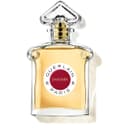
The powerful red bottle of Samsara was designed by Robert Granai, inspired by Khmer dancers depicted in statues at the Musée Guimet. As for the flamboyant red color of the glass, it of course references the sacred color of the East, which also appears as a watermark across the various visuals for Samsara. Finally, the golden cap is designed to represent the eye of Buddha, a symbol of the awakening of consciousness and of a deep spirituality oriented toward meditation.
As for the fragrance of Samsara, imagined by Jean-Paul Guerlain for his companion, a devotee of sandalwood and jasmine, it offers for the first time a rare blend of oriental notes and woody notes, quite unusual for women's fragrances at the time.
Yet the citrus top notes, thanks to lemon and bergamot, and the aromatic notes of tarragon, well conceal the game of such a captivating oriental scent by opening on green and fresh notes. It is in the heart that the magic of the flower overtakes with the sweetness and exoticism of ylang-ylang, jasmine, and also soft rose, so dear to the Guerlain family, or even the very Western carnation. It is indeed in the base notes that we discover the sensual, intoxicating depths of sandalwood, tonka bean, benzoin and vanilla. Note here that sandalwood, chosen and even harvested with care by the perfumer, takes for the first time in perfumery a central place in the composition.
If for some, Samsara was, before being a fragrance, a commercial concept aimed at reviving Guerlain sales, which had been somewhat stagnant since Chamade in 1969, this is not the case. As a worthy successor to the beautiful Shalimar, Samsara, with its deep and harmonious balances, captivates as much through its imaginative and highly creative spiritual concept. Like a rebirth, as its name suggests, Guerlain and Samsara went on to conquer the hearts of women in search of a fragrance with mysterious and powerful charms and a rare sillage.
Olfactory pyramid
- Top notesThe first minutes
- Heart notesThe heart of the perfume
- Base notesWhat lingers
What the community says
Season
Occasion
Create an account to keep your votes and find your notebook.