
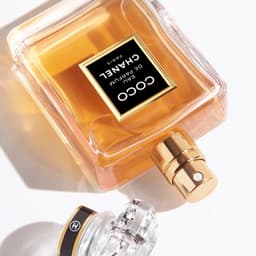
The perfume for women Coco by Chanel It was in 1984 that the house of Chanel decided to call on the talented perfumer Jacques Polge in order to pay tribute to its founder. To do so, the house created a perfume named Coco. It was very quickly described as a baroque perfume and its intoxicating notes seemed ideally designed to leave no one indifferent. This fragrance is at once voracious, mysterious and bewitching. It is a myth of perfumery filled with luxury and refinement, just as the iconic Gabrielle Chanel herself was.
Antaeus, then the famous Egoïste, boldly mimicked the new perfumed era that Chanel embarked upon in the 80s with the arrival of its new in-house perfumer Jacques Polge. The man delights as much in creating within the traditional Chanel spirit as in offering appealing novelties, and he would demonstrate this once again with the magnificent Coco, born in 1984. A baroque fruity floral, Coco innovates while bringing back the powerful scents that Gabrielle Chanel favored, a marvel!
Coco, Jacques Polge's very first feminine perfumed masterpiece for Chanel
Jacques Polge's arrival in 1978, succeeding Henri Robert, creator of Cristalle, N°19 and also Pour Monsieur, brought a new breath of creativity and innovation to the house of Chanel. Indeed, while Henri Robert had nothing to prove of his talents as a perfumer, the sudden death of Chanel's beloved founder, Gabrielle Chanel, plunged the house into a mourning that no longer allowed for the same boldness as during the unrivaled presence of the famous Coco.
Jacques Polge thus knew how to breathe a new era into Chanel from his arrival by daring to combine traditional Chanel scents (jasmine, aldehydes…) with bold novelties. He thus created Antaeus and then Egoïste, perfectly in this spirit of blending a prestigious past with impertinent novelties. The same goes for Coco, in 1984, which would be the first feminine perfume to be born without the inspiring presence of the house's beloved founder.
Yet in Coco, the spirit of Gabrielle Chanel remains far more present than one might imagine. Its highly oriental accords immerse us in Gabrielle Chanel's baroque universe and carry us into her world, which was for years a world of oriental splendors and swirling scrolls. In Coco, the spirit of Gabrielle Chanel, known as Coco, endures more than ever.
Great creations, such as precisely Coco (1984). Jacques Polge points out that it is the first feminine perfume that Gabrielle Chanel did not choose herself, but one that evokes another facet of her passionate and baroque personality, reflecting her Parisian apartment on Rue Cambon. Jacques Polge on Coco by Chanel, for Les Echos.
Olfactory chiaroscuro that illuminates Coco with the unmatched presence of Gabrielle Chanel
Gabrielle Chanel's whimsical and bold spirit is thus, more than ever, at the heart of this Coco, which presents itself with strength and brilliance to women of the 80s. A spirit that was depicted through multiple contrasts, just as this Coco plays at times with luminous bursts, at times with dark swirls, to sketch the olfactory portrait of a woman of unmatched genius.
Thus the fresh and sparkling top notes of Coco, composed around citrus and fruity notes, join the delicate and so feminine flowers of the heart to represent the sun-kissed side of the Chanel woman, but also of Gabrielle herself. On the other hand, the dark beauty of the spices in the heart, paired with the dark power of the depths, made up of animalic notes and woody notes, become soft, mysterious, nocturnal swirls, better expressing the baroque spirit so fitting for Coco Chanel.