
Christian Dior
Poison
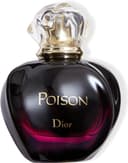
Poison is the first women's fragrance Dior released without the founder's name on the box. Édouard Fléchier overdoses tuberose over a base of honey and opoponax, in an amethyst apple bottle designed by Véronique Monod. Launched in 1985, it imposed a frontal femininity the decade adopted, and one critics still argue over forty years later.
- Brand
- Christian Dior
- Launch year
- 1985
- Perfumer
- Gender
- Women
- Olfactory family
- Oriental
- Concentration
- Eau de Toilette
- EAN
- 3348900011632 (50 ml) · 3348900011687 (100 ml)
Published · Updated
Share
Where to buy
Links to our partner shops.
1985. Dior puts on sale a fragrance whose name alone is enough to start people talking, breaking with the custom that a house fragrance carried its founder's name.
A name registered before the formula
Dior secured the name Poison in 1983, before the juice existed. The house wanted a word that would stop a passerby, on the model of Opium at Yves Saint Laurent, whose success owed as much to scandal as to smell.
Susan Biehn, then head of advertising at Dior, defended an adventurous name for an adventurous product, chosen to make the buyer pause a moment at the counter.
Édouard Fléchier
The juice chosen was Édouard Fléchier's, a perfumer trained in Grasse, and his first great international success. Persolaise associates Jean Guichard with the composition; the house credits only Édouard Fléchier.
An apple that became a collection
Success turned Poison into a line. Tendre Poison opened the series in 1994, Hypnotic Poison arrived four years later, Pure Poison in 2004. Midnight Poison appeared in 2007 and Poison Girl in 2016.
The house completed the family with an extrait de parfum signed by François Demachy, which takes up the original accord while pressing on coriander, vanilla, tuberose absolute and May rose absolute.
Olfactory pyramid
What the community says
Season
The community finds it similar to…
- Michelle — Balenciaga1 vote
- Paradoxe — Prada1 vote
- Paradoxe Intense — Prada1 vote
An error or a gap on this perfume page? Report it
Create an account to keep your votes and find your notebook.
The advertising
Isabelle Adjani, the 1985 face
Dior gave Poison to Isabelle Adjani from the 1985 launch, and the actress remained the face of the campaign for several years.
Dior chose Isabelle Adjani to carry Poison from 1985, and the actress remained the face of the campaign for several years. Her angelic image defuses what the name of the fragrance leads one to expect, and the campaign plays on that gap.
The campaign rests first on the word. Susan Biehn, then head of advertising at Dior, defended an adventurous name for an adventurous product, meant to make people hesitate for a second. The avowed model is Opium.
The name delivered. Neil Chapman files Poison among three fragrances of the 1980s turned away from restaurants and boutiques for their power, alongside Obsession and Giorgio.
From the same line
More perfumes from Christian Dior
Also composed by Edouard Fléchier
- In BlueCourrèges
- Acqua Di Gio FemmeArmani
Similar perfumes
Similar notes and family, from other houses.
- Shalimar Série Limitée 2020Guerlain
- Opium Eau de ToiletteYves Saint Laurent
- Ambra PrimordiaAlchymia Studio
- 1957Chanel
- Amber pour Homme IntensePrada
- LuneorMemento Mori
- Scandal by NightJean Paul Gaultier
- L'Ambre des Merveilles CalligraphieHermès