
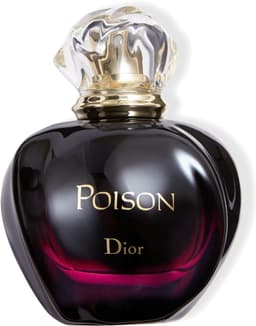
Poison: The Poison woman holds many mysteries... The famous Poison is the star fragrance of the 1980s! Whether one loves it or hates it, Dior's Poison left no one indifferent. Few fragrances have marked their era as much, yet Poison and its intoxicating oriental notes remains a great classic of perfumery.
Released in 1985, Poison represents the forbidden fruit. Both highly feminine and ultra seductive, the Poison fragrance achieved staggering success. Bewitching, Poison is truly the star of the 1980s. The primary goal of the Poison fragrance was to be provocative... There is no doubt that goal was achieved. Provocative, disconcerting, mysterious, even shocking, Poison exceeded all of the house of Dior's expectations. Poison remains the fragrance of the eternal seductress, one who answers only to her own desires, a most audacious composition signed by Edouard Fléchier.
Edouard Fléchier imagines the forbidden fruit: Dior Poison
Born in Grasse in 1949, Edouard Fléchier grew up amid fields of jasmine and rose. He naturally joined the Roure school (now Givaudan) before going on to work there. Edouard Fléchier is considered one of the most creative perfumers of his generation. Highly sensitive and inventive, Edouard Fléchier likes to create emotions while conjuring timeless scents. Edouard Fléchier is responsible for beautiful fragrances such as Courrèges in Blue by Courrèges, Acqua Di Gio pour Femme by Armani, and Une Rose by Frédéric Malle.
Dior's Poison, a fragrance between love and aggression
Poison opens with a bold, unusual pairing that combines fruit with plum, and spice with coriander and pink pepper. Because its origin is uncertain, coriander is also called Arabic parsley and Chinese parsley. The name coriander comes from the Greek koris, meaning bedbug, owing to the smell of its fresh leaves, which recall that of bedbugs. In Europe, coriander has long been used for its medicinal properties. It is also a highly prized spice in Middle Eastern and Indian cuisine. In perfumery, coriander essence is obtained by distilling the powdered seeds. Coriander gives off powerful, camphoraceous, peppery, even lavender-like tonalities. The heart of Poison then continues with the same intensity, combining cinnamon, tuberose, orange blossom, carnation, and jasmine, offering floral, honeyed, and intense notes. Although tuberose originates from Mexico, it was introduced to Grasse in the 17th century. Tuberose is a supremely feminine flower. Its scent is at once powerful, heady, and jasmine-like. Tuberose is sensual, and the flower is even said to be aphrodisiac. The flowers are picked by hand, and the floral absolute is extracted using volatile solvents. The base notes of Poison create a whirlwind of intoxication, so sensual and enveloping are they. They combine opoponax, vanilla, white musks, sandalwood, and honey. It was the great glassmaker Maurice Marinot who created the Poison bottle. The mystery of the fragrance is further heightened here by the amethyst color of the bottle. It also bears the shape of an apple, recalling once more that Poison is the result of the forbidden fruit.