
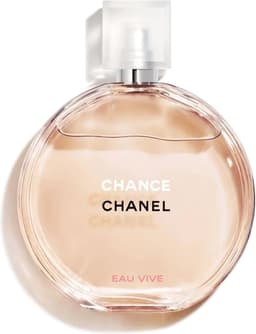
Chance Eau Vive is the fourth interpretation of Chance, launched by Chanel in June 2015. Olivier Polge created the formula, the first Chance he composed for the house. Chanel describes it as a floral-zesty fragrance: grapefruit and blood orange open it, a jasmine heart carries it, and cedar and iris accords close it, in the line’s round bottle.
Chanel describes a floral-zesty fragrance, awakened by grapefruit and blood orange, whose freshness bursts out at the top. A jasmine heart unveils its femininity, according to the house; cedar and iris accords shape its base and its elegance.
Top
The launch announcement, in June 2015, puts grapefruit in the foreground, lifted by a touch of blood orange. The house names the same two citrus fruits and credits them with the burst of freshness that opens the fragrance.
Heart
Jasmine forms the heart that Chanel describes. The notes released when the fragrance came out place it at the center of the composition, between the citrus of the opening and the woods of the base, without naming any other flower.
Base
Cedar and iris form the accord that the house highlights at the base of the fragrance. The notes released at launch add vetiver and white musks, which Chanel does not repeat in its current description.
What the label declares
The list published in Europe begins with alcohol, fragrance and water. It shows a UV filter, butyl methoxydibenzoylmethane, along with a red colorant, CI 14700, and a yellow one, CI 19140; the printed formula code is IL79-1.
The rest declares twelve allergens: limonene, linalool, citronellol, benzyl salicylate, alpha-isomethyl ionone, hexyl cinnamal, citral, geraniol, eugenol, coumarin, benzyl alcohol and farnesol. Neither lilial nor lyral.
For Latin America, the house declares a more complete list, under another code, PS000070A. It names the essential oils of bergamot, bitter orange, lemon and orange blossom, patchouli oil, rose, santalol, vanillin and tetramethyl acetyloctahydronaphthalenes, a woody, ambery synthetic material.
What stays out
The mandarin, peach, aldehydes and vanilla sometimes attributed to Eau Vive appear neither in the house’s description nor in the launch notes. Rose appears only in the detailed ingredient list, never among the declared notes.
Similar perfumes
Similar notes and family, from other houses.
- Amor Amor Eau de ParfumCacharel
- The Beat pour Femme Eau de ParfumBurberry
- My Way Le ParfumArmani
- Irrésistible Eau de ToiletteGivenchy
- FéerieVan Cleef & Arpels
- Joy ForeverJean Patou
- Narciso Rouge Eau de ParfumNarciso Rodriguez
- Clair de MuscSerge Lutens
From the same line
- Chance Eau de Parfum
- Chance Eau Fraîche
- Chance Eau Tendre
- Chance Eau Tendre Eau de Parfum
- Chance Eau Splendide Eau de Parfum
The whole line on the blog: Chance by Chanel: the whole line, from 2002 to 2025
More perfumes from Chanel
Also composed by Olivier Polge
- Sport for WomenBurberry
- FlorabotanicaBalenciaga
- Pure PoisonChristian Dior
- La Vie est Belle x Atelier PaulinLancôme