
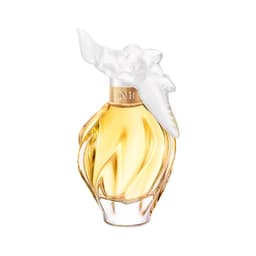
Launched in 1948, L’Air du Temps is the fragrance that made the house of Nina Ricci. Francis Fabron ties carnation and clove to a bouquet of gardenia, jasmine and rose, over a powdery base of iris, sandalwood and oakmoss. Robert Ricci wanted a bottle that carried peace: Marc Lalique gave it, in 1951, its two crystal doves. Rewritten across the decades, it remains one of the most widely recognized spicy florals in the world.
A top so brief it is easy to miss
The opening holds to two gestures: bergamot for freshness, aldehydes for that soapy halo that marks postwar perfumery. It is short, and deliberately so: the fragrance does not linger before entering its subject.
Commercial listings readily extend this top with neroli, peach or rosewood. These notes always trace back to a single source, copied from site to site, and still await independent confirmation.
The heart, where carnation commands
Carnation is the signature, and it does not work alone: clove extends its peppery facet. This spicy accord laid over a floral bouquet is what the house claims as a first in the history of perfumery.
Around it, three flowers hold the volume. Gardenia brings a creamy, slightly green opulence, jasmine the density, rose the roundness. Together they form a dense bouquet, which reviewers describe as frankly white.
This claim of primacy remains a statement from the house, never confirmed by an independent history of perfumery. It is plausible given the output of 1948, but it is cited as an argument, not as a fact.
A powdery base, and dated in the best sense of the word
The powdery veil that made the fragrance’s reputation comes from iris and violet. It is this powder, more than the flowers, that wearers recognize after an hour, and that divides opinion as much as it attaches loyalty.
Beneath it, sandalwood and cedar bring warmth, oakmoss a green, bitter foundation, white musks and amber a skin-like sweetness. It is a classic perfumery base, now rare.
Benzyl salicylate occupies a notable place in the formula: it is what gives that silky, almost sun-kissed texture. Often presented as a novelty of 1948, its primacy is not attested by any verifiable source.
What can be smelled today
This molecule now falls among the substances whose presence must be declared. Oakmoss is also subject to restrictions. The classics built on these materials have all been rewritten, and this one was no exception.
Those who knew the older versions describe a sharper, spicier carnation, a more biting green foundation, where recent bottles lean toward the powdery. No reformulation date has ever been made public.