
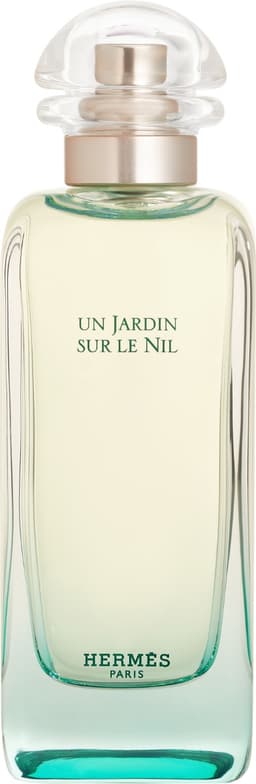
Un Jardin sur le Nil is the second of the Hermès Jardins, composed in 2005 by Jean-Claude Ellena after a trip to Aswan. The house describes it as a green and woody fragrance in which a tangy green mango, a delicate lotus and sycamore wood answer one another, along with incense and calamus. Its bottle, in glass shaded with green, evokes the banks of the Nile.
Hermès describes Un Jardin sur le Nil as a green and woody fragrance: a tangy green mango, a delicate lotus, an elegant sycamore. Ellena adds, in his words published by the house, incense and calamus, the fragrant rush that grows by the water.
The house does not divide these materials by stage. Its Swiss page pairs mango, lotus and fragrant rush with incense and sycamore wood; Persolaise places the fruit in the top and the incense in the base, and Robin of Now Smell This a wood beneath the green.
Mango thus holds the top, lotus and calamus the heart, incense the base, together with the sycamore wood that the house names among its three main materials and that accompanies the incense at the base of the fragrance.
Green and fruit
Wikiparfum ranks the fragrance among the woody scents and also cites tomato, grapefruit, carrot seeds, hyacinth and peony. Robin and Persolaise mostly smell a bright grapefruit in the opening, which Persolaise compares to that of Cologne Bigarade, signed by Ellena for Frédéric Malle.
What the label declares
The ingredient list published by Hermès has twenty-two entries. After alcohol, water and fragrance comes tetramethyl acetyloctahydronaphthalenes, a synthetic wood, followed by a bitter orange peel oil, limonene, hydroxycitronellal, citronellol, hexyl cinnamal and pinene.
It lists three UV filters, ethylhexyl methoxycinnamate, ethylhexyl salicylate and butyl methoxydibenzoylmethane, terpenes such as beta-caryophyllene and terpinolene, and the regulated allergens geraniol, linalool, citral and farnesol. No colorant appears.
What stays out
Grapefruit, tomato leaf, hyacinth and vetiver, often attributed to the fragrance, are mentioned here but not listed as notes: the house does not name them among its materials. The peony and carrot seeds cited by Wikiparfum are treated the same way.
Similar perfumes
Similar notes and family, from other houses.
- MuguetMolinard
- Cozy Pumpkin LatteZara
- Dahlia Divin Eau InitialeGivenchy
- Passage d’EnferL'Artisan Parfumeur
- Passage d’Enfer ExtrêmeL'Artisan Parfumeur
- Tower BridgeTha Beauty
- La Belle Paradise GardenJean Paul Gaultier
- Rose de CourrègesCourrèges
From the same line
More perfumes from Hermès
Also composed by Jean-Claude Ellena
- Eau de CampagneSisley
- Déclaration Eau de ToiletteCartier
- First Eau de ToiletteVan Cleef & Arpels
- In Love AgainYves Saint Laurent