
Un Jardin sous la Mer
Hermès dives into the blue immensity For over two decades, Hermès's Un Jardin collection has invited exploration of gardens the world over – earthly gardens, hanging gardens, secret gardens. But never before had the house dared to cross the liquid frontier to explore that fascinating and largely unexplored territory: the underwater garden. With Un Jardin Sous La Mer, Christine Nagel, in-house perfumer since 2016, achieves in 2026 what might seem a poetic impossibility: composing the scent of the invisible, capturing in a bottle the essence of a silent world where air does not exist.
Where to buy
Unlike the Mediterranean gardens scented with fig trees, the banks of the Nile perfumed with green mango, or the Venetian lagoons flowering with magnolia, the underwater garden poses an unprecedented conceptual challenge for the perfumer. How does one translate olfactorily a universe devoid of air – that indispensable vector for any olfactory perception? How does one evoke those kelp forests swaying in cold currents, those Mediterranean seagrass meadows, those multicolored corals that draw fairy-tale landscapes dozens of meters below the surface? Christine Nagel answers this seemingly unsolvable equation with a composition of remarkable intelligence, one that does not seek to reproduce but to suggest, that does not imitate but evokes.
Creative genesis: from a childhood dream to a mature fragrance
In the creation notebooks that Hermès sometimes publishes to accompany its launches, Christine Nagel recounts the unexpected origin of Un Jardin Sous La Mer. The inspiration reportedly did not come to her during an exotic dive in the Maldives or the Red Sea – those postcard destinations where one expects to find underwater wonder. No, it was during a simple family walk along the Brittany coast, at low tide, that the idea is said to have taken root. Watching her granddaughter explore with fascination the tide pools trapped between the rocks, discovering retractile anemones there, furtive crabs, seaweed of surprising colors, the perfumer reportedly had this revelation: the underwater garden need not be tropical and exotic. It also exists a few steps from our shores, in those intertidal zones that the sea uncovers and covers again with the rhythm of the tides.
This approach determines the entire olfactory philosophy of Un Jardin Sous La Mer. Rather than composing a conventional aquatic fragrance – those turquoise juices saturated with synthetic marine molecules that smell more of shower gel than ocean – Christine Nagel chooses the path of minerality, of natural iodine, of marine vegetation. She draws inspiration less from the postcard image of the diver moving among tropical fish than from the coastal walker who breathes in the salty sea spray, who crumples a sun-dried seaweed between the fingers, who inhales that particular scent of rocks exposed at low tide – that blend of salt, kelp, shells and wet stone.
This creative stance fits perfectly within the DNA of the Un Jardin collection. Since Un Jardin en Méditerranée, inaugurated in 2003 by Jean-Claude Ellena, each opus has favored poetic evocation over realistic description, subjective sensation over botanical inventory. These fragrances do not seek to catalog scientifically the essences of a place but to capture its soul, its atmosphere, that fleeting impression that remains etched in memory long after the journey. Un Jardin Sous La Mer perpetuates this tradition of impressionistic restraint, where a few touches suffice to conjure an entire landscape. To explore the composition of Un Jardin Sous La Mer in detail, this marine creation reveals a radically innovative approach to aquatic notes in contemporary perfumery.
Olfactory cartography of a sunken world
Composing a marine fragrance without falling into the clichés of the genre – the Calone molecule that smells of synthetic melon, garish aquatic accords, stereotypical marine notes – represents one of the most perilous exercises in modern perfumery. Christine Nagel approaches it with the same minimalist philosophy that characterizes all her creations for Hermès: favoring quality over quantity, the sketch over the overloaded drawing, the poetic haiku over the encyclopedic description. Un Jardin Sous La Mer is built around three olfactory strata that evoke the different levels of ocean depth.
Shimmering surface: the saline, iodine-tinged awakening
From the very first spray, Un Jardin Sous La Mer strikes with its resolutely iodine-tinged opening that immediately evokes sea air. But this salty note has nothing in common with conventional oceanic accords that often smell like detergent or chlorinated pool water. Here, Christine Nagel works with the iodine naturally present in certain plant-based raw materials – notably seaweed – to create an impression of organic, almost tactile salinity. It brings to mind the sea spray that hits the face on a windy walk along the pier, that salty taste that settles on the lips, that slightly sticky feeling on the skin after a swim in the sea.
This salinity blends with citrus notes – probably Japanese yuzu and Calabrian bergamot – that bring an almost sparkling vivacity, like light refracting on the surface of the water. Yuzu, that Asian citrus with such a distinctive scent between lime, mandarin and grapefruit, possesses a watery quality that makes it particularly suited to marine compositions. Its lemony freshness is never aggressive but rather slightly softened, almost hazy. Bergamot, for its part, brings its characteristic green roundness and that delicate bitter edge that evokes citrus peels being crushed between the fingers.
To these watery citrus notes is added a mineral touch that is difficult to identify precisely – likely an accord built around metallic and stony notes that evoke wet granite, pebbles polished by waves, that very particular scent of stone in contact with seawater. This minerality creates an impression of almost cold freshness, as if plunging one's hand into water at 15 degrees. It keeps the composition from tipping into tropical sweetness and maintains that tension between vivacity and depth that characterizes the fragrance from beginning to end.
Twilight zone: the underwater plant ballet
As Un Jardin Sous La Mer develops on the skin, one descends metaphorically toward the zones where light begins to fade, where colors become less vivid, where plant life takes on astonishing forms to adapt to the lack of photosynthesis. The heart of the composition introduces green notes of a very particular nature: these are not the chlorophyll greens of terrestrial foliage but darker, deeper greens, slightly iodine-tinged, that evoke marine algae.
Christine Nagel reportedly worked with seaweed absolutes – rare and costly raw materials obtained by extraction from kelp or bladderwrack. These brown algae that populate the Atlantic coasts possess a complex scent, at once vegetal, marine, smoky and slightly animalic. Their scent evokes simultaneously green chlorophyll, salty iodine and that umami note found in certain fermented foods. In perfumery, seaweed absolute brings an authentic marine depth, far removed from synthetic aquatic notes that smell clean and fresh. It smells of the true ocean, with its raw force, its almost animalic salinity, its wild character.
This algal note could be complemented by marine floral facets – perhaps a touch of sea lily or sambac jasmine treated in a way that extracts its most watery and least indolic nuances. The sea lily, also called pancratium maritimum, is that white flower that grows on Mediterranean coastal dunes, between sand and sea. Its delicate scent blends floral freshness with a slight salinity, as if sea spray had permeated its petals. Used sparingly, it brings to the heart of Un Jardin Sous La Mer that aquatic femininity that keeps the fragrance from becoming too austere or too masculine.
One also detects notes of sea cucumber or marine violet – those green-metallic touches that create an impression of wet vegetal freshness, like the scent of a stem just broken, its sap flowing out. This aquatic greenness keeps the composition in a light, airy register despite the underwater theme, avoiding any risk of heaviness or olfactory saturation. The fragrance breathes, ripples, evolves with the same fluidity as an alga swaying in the current.
Peaceful abyss: the mineral memory of the depths
Contrary to expectations, Un Jardin Sous La Mer is not built on a massive woody base as so many modern marine fragrances do, compensating for aquatic lightness with powerful synthetic woods. Christine Nagel remains faithful to the spirit of the Un Jardin collection, which favors transparency, lightness, that quality of artistic blur that allows the fragrance to remain evocative rather than descriptive. The base of Un Jardin Sous La Mer plays on minerality more than warmth, on memory more than presence.
One finds notes of ambergris – that legendary substance produced by sperm whales and aged for years in the ocean. Ambergris possesses a unique scent, at once marine, animalic, musky and slightly tobacco-like. It smells of the deep ocean, the mystery of the abyss, that marine life we know only through rare accounts. In modern perfumery, synthetic reconstructions of ambergris are most often used – the natural substance being rare and protected – but the scent remains fascinating: salty-animalic, sweet-musky, marine-earthy. It brings to Un Jardin Sous La Mer that almost spiritual depth, that sense of antiquity and mystery.
To this ambergris are probably added white musks – those synthetic molecules that create an impression of clean skin and freshly laundered linen. But here, the musks do not smell of laundry: treated with subtlety, they evoke instead skin after a swim in the sea, slightly salty, warmed by the sun, still carrying the memory of water. They create that sillage close to the skin, that impression that the fragrance emanates from oneself rather than covering the wearer.
Finally, notes of driftwood – wood bleached and polished by years of immersion and then stranding – bring a slightly woody touch without heaviness. Driftwood smells less of wood than of salt, less of forest than of shore. Its pale, faded scent evokes the passage of time, the patient action of the ocean that transforms, softens, polishes. It creates in the base of Un Jardin Sous La Mer that impression of serenity and timelessness, as if the fragrance had always existed, as if one had already smelled it somewhere in a past life.
Watercolor bottle: when design embraces depth
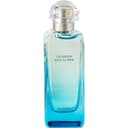
True to the tradition of the Un Jardin collection, the bottle of Un Jardin Sous La Mer takes up the emblematic architecture designed by Fred Rawyler and inspired by the lanterns of vintage cars. This distinctive shape – flat facets, softened angles, protective cap – has been used since Un Jardin en Méditerranée in 2003 with chromatic variations that evoke each destination. For this underwater dive, Hermès plays on a gradient of blues that captures the stratification of ocean depths.
The glass of the bottle comes alive with a subtle gradation running from a nearly transparent light turquoise at the base – evoking the shallow waters where light penetrates generously – up to an almost indigo deep blue at the top, suggesting the mysterious abyss where a perpetual semi-darkness reigns. This gradient coloring technique requires exceptional glassmaking skill: each bottle is unique, with the shades varying slightly from one to another, like the changing reflections of the sea depending on the hour and the weather.
From certain angles, the glass appears almost translucent, hinting at the amber juice it contains – for contrary to what one might imagine, the fragrance itself is not blue but a pale, almost colorless yellow, true to the Hermès tradition that rejects artificial colorants. This transparency creates a fascinating optical play: depending on the light and the position of the bottle, one sees at times the bluish glass, at times the amber liquid, at times a fusion of the two that evokes the play of light underwater.
The box protecting the bottle receives just as much artistic attention. Hermès called on an illustrator specializing in underwater landscapes – perhaps a naturalist or marine biologist turned artist – to create an original work that adorns the six faces of the box. It reveals a poetic vision of the seabed: not multicolored tropical fish or flamboyant corals, but rather those more temperate and lesser-known landscapes of the French coasts. Kelp forests swaying like trees in the wind, seagrass meadows hiding seahorses and cuttlefish, rocks covered with anemones and sponges in pastel hues.
The colors of the illustration – dominant blue-greens, touches of ochre and brown, bright points of white – create a soothing and contemplative atmosphere. It is far from the documentary sensationalism of wildlife imagery: the artist favored an almost meditative approach, inviting reverie rather than spectacular wonder. This visual restraint perfectly reflects the olfactory philosophy of the fragrance: suggesting rather than imposing, evoking rather than describing.
The explorers of the depths: who is this marine odyssey for?
Un Jardin Sous La Mer traces the olfactory portrait of a person – man or woman indifferently, as the composition fully embraces its unisex nature – who possesses that rare quality one might call quiet depth. There is no need to be a professional diver or marine biologist to make this fragrance one's own: it is enough to have that particular sensitivity to the beauty of natural elements, that capacity to marvel at what others would deem ordinary – a tide pool between rocks, a piece of driftwood sculpted by waves, the dance of a translucent jellyfish.
This Un Jardin Sous La Mer person probably shuns crowds and superficial social gatherings. This person prefers solitary walks on deserted beaches in November to summer crowds on packed beaches, and finds more beauty in a misty Brittany coastal landscape than in an Instagram-worthy tropical sunset. Their relationship to luxury favors discretion over ostentation, lasting quality over fleeting trends, authenticity over appearances.
Professionally, one readily imagines this person working in sea-related occupations – oceanographer, naval architect, restaurateur specializing in sustainable seafood – or at least professions that value in-depth reflection and sharp expertise: researcher, writer, specialized photographer, documentary filmmaker. Activities that require that same quality of concentration and patience demanded by the observation of the underwater world.
Un Jardin Sous La Mer is particularly suited to temperate climates and transitional seasons. Its mineral freshness makes it perfect for still-cool spring days, when the sun begins to warm the air without reaching summer heat. It also shines in autumn, that transitional season when the sea reclaims the beaches abandoned by summer visitors. One can even imagine it worn in the depths of winter, on those bright days when invigorating cold enhances rather than clashes with its iodine-tinged freshness.
On the other hand, in the tropics or during summer heat waves, Un Jardin Sous La Mer might seem almost too refreshing, its cold minerality creating a disconnect with the ambient heat. It is a fragrance of temperate latitudes, of those regions where the sea remains cool even in August, where one still wears a sweater in the evening despite the June sun.
The sillage of Un Jardin Sous La Mer remains moderate, true to the spirit of the collection, which favors olfactory intimacy over spectacular projection. In a crowded elevator, the fragrance will not saturate the space but will rather create a bubble of freshness that intrigues without disturbing. At the office, it refreshes the atmosphere without distracting colleagues. At dinner, it does not compete with culinary aromas but adds a discreet personal touch.
Longevity ranges between 4 and 6 hours on normal skin – an honest performance for an Eau de Toilette of this lightness. Hermès could have reinforced tenacity by adding powerful synthetic fixatives, but that would have betrayed the very spirit of the fragrance. Un Jardin Sous La Mer is not designed to mark its olfactory territory all day: it is conceived as a refreshing parenthesis, a poetic escape, a moment of contemplation renewed whenever the desire arises.
This relative evanescence is in fact an integral part of the olfactory experience. Like the tide that rises and falls, like the waves that follow one another on the shore, Un Jardin Sous La Mer appears and fades in natural cycles. It is sprayed in the morning to begin the day in marine freshness. By lunchtime, it has melted into the skin, leaving only a mineral-musky memory. In the mid-afternoon, a fresh application revives the iodine-tinged sensation. By evening, it has vanished, making way for dinner fragrances or an evening scent if one wears one.
An olfactory odyssey into a territory hitherto unexplored by the house of Hermès, Un Jardin Sous La Mer proves that even after 23 years of existence, the Un Jardin collection retains its capacity to surprise and innovate. Between the iodine-tinged salinity of sea spray and the mineral sweetness of ambergris, between the algal greenness of kelp and the musky transparency of skin after a swim, between shimmering surface and peaceful depths, this fragrance invites a meditative dive into the blue immensity. For exploring underwater gardens requires neither an oxygen tank nor a neoprene wetsuit – a bottle of Eau de Toilette and a little imagination suffice to discover these sunken landscapes where silence is disturbed only by the steady beat of one's own heart.
Olfactory pyramid
- Heart notesThe heart of the perfume
What the community says
Season
Create an account to keep your votes and find your notebook.