
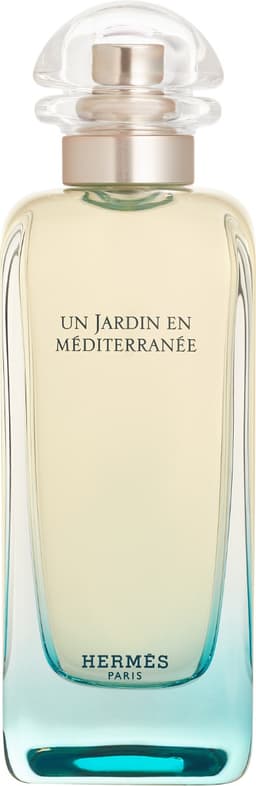
Un Jardin en Méditerranée is the first of the Parfums-Jardins, launched by Hermès in 2003. Jean-Claude Ellena drew on the Tunisian garden of Leïla Menchari, in Hammamet, to create it. The house describes it as a fruity, woody fragrance combining a sweet fig tree, green lentisk and delicate oleander, in a bottle whose glass is tinted with a blue gradient.
Hermès describes Un Jardin en Méditerranée as a fruity, woody fragrance: a sweet fig tree, notes of green lentisk, a delicate oleander. Lentisk is the maquis shrub that yields mastic; oleander is a flowering shrub, distinct from bay laurel.
Hermès does not specify where these materials sit in the fragrance’s development. Osmoz places the fig tree, lentisk and a laurel in the heart, and a red cedar and the fig tree in the base; the label declared by Hermès lists a bergamot peel oil.
Bergamot therefore holds the top, the fig tree and lentisk the heart. Oleander remains described in prose; red cedar, which the house does not name, is not retained, so no base material is declared.
What the label declares
Hermès declares thirty-one ingredient entries for its eau de toilette. After alcohol, water and fragrance come tetramethyl acetyloctahydronaphthalenes, a synthetic wood, bergamot peel oil, linalyl acetate, a bitter orange peel oil, rose ketones and camphor.
Three UV filters appear, ethylhexyl salicylate, ethylhexyl methoxycinnamate and butyl methoxydibenzoylmethane, along with an oakmoss extract, the regulated allergens limonene, linalool, geraniol, hydroxycitronellal, citral and citronellol, and three colorants, yellow, red and blue.
What stays out
Rose, eucalyptus, laurel and white musks, long attributed to the fragrance, are not among the materials the house names and are not retained. Orange blossom, lemon, cypress and juniper, often cited, are not retained either.
Similar perfumes
Similar notes and family, from other houses.
- Infusion de FiguePrada
- HiM by Hanae Mori Eau de ParfumHanae Mori
- Noir pour FemmeTom Ford
- AbyssaeL'Artisan Parfumeur
- Corsica FuriosaParfum d'Empire
- Mugler WomanityThierry Mugler
- Black Opium Illicit GreenYves Saint Laurent
- Premier FiguierL'Artisan Parfumeur
From the same line
More perfumes from Hermès
Also composed by Jean-Claude Ellena
- In Love AgainYves Saint Laurent
- Déclaration Eau de ToiletteCartier
- Eau de CampagneSisley
- First Eau de ToiletteVan Cleef & Arpels