
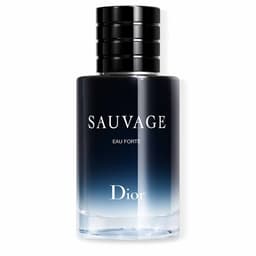
DIOR Sauvage Eau Forte Parfum sans alcool by Christian Dior is a masculine composition with spices in the top notes, revealing a lavender heart before settling into a woody, musky base.
The published pyramid is short, which is unusual for the house and speaks volumes about the intent: each tier must carry weight without the usual padding of masculine fougères. The opening rests on a cold spices accord, understood as peppery, vibrant materials worked free of any warmth—no sweet cinnamon, no candied clove, no cumin. Dior states that water here prolongs the vividness instead of carrying it away: the spices, the house says, intensify and gain in longevity.
Elemi accompanies this opening and forms its key. This gum, a close relative of incense, carries a lemony, peppery side layered with an almost turpentine-like resinous facet. It thus occupies exactly the place left vacant by lemon and bergamot: it provides the citrus bite without its volatility, which is what allows the top to remain legible well after the point at which a zest would have evaporated.
The heart returns entirely to lavender, on which the whole genre rests, in a treatment the house describes as whitened. What the term covers: the camphoraceous, hay-like and herbaceous facets that give this flower its rustic character and its age are planed down, keeping only a powdery, clean, almost floral freshness. It then ceases to be an aromatic signal and becomes a texture, and it is at this point that the fragrance most clearly departs from the territory of its predecessors.
At the base, the house sticks to two generic mentions, woody and musky, without naming any specific material. The woods here are dry rather than amber, the musks of a white character, and both fulfill a function that the medium makes critical: in an aqueous formula, it is these heavy materials that hold the rest on the skin. Dior describes woods swollen by water calling to the musks in the same breath, an image that covers a simple formulation reality, that of a fixative pushed to an unusual level.
The architecture deserves attention, as it explains both the classification and the reactions. A canonical fougère is written as lavender, coumarin and moss; the published pyramid mentions neither here. The genre thus remains recognizable by its framework, not by its ornaments—hence the sensation, often reported, of a herbaceous and dry juice, closer to an herbalist's preparation than to a mass-market fragrance.
The removal of alcohol finally changes the way these tiers are read. Without the initial surge produced by alcoholic evaporation, the fragrance rises less high but settles in earlier: the distinction between top, heart and base flattens out, and the complete accord is perceived fairly quickly rather than as a succession. Wearers describe it, moreover, as a scent that stays close to the body after a few hours, which corresponds less to a lack of longevity than to a diffusion conceived differently.