
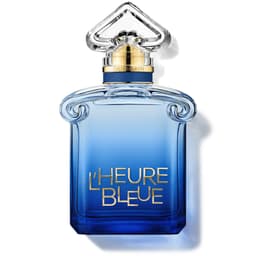
L'Heure Bleue 2026 is an Eau de Parfum by Guerlain composed by Delphine Jelk, which borrows the name of the 1912 classic without borrowing its formula. An ozonic accord opens on pear and neroli, a double iris, custom-made tincture and butter, holds the heart with jasmine, and vanilla closes on ambroxan and musks. The house classifies it as floral amber.
A frankly divided reception: the mainstream press hails the house's most important launch in a decade, specialist criticism demolishes the ozonic accord, and the most persistent grievance concerns less the juice itself than the reuse of the name of a classic still on sale.
Olfastory’s review
A reception divided as much over the name as over the juice
Few recent launches have been this divisive. The disagreement first concerns a point that is not olfactory: having given an entirely new creation the name of a 1912 perfume still in the catalogue, and having distinguished the older one only by adding its vintage. Part of the audience sees this as a commercial substitution, all the more so since nothing on the new bottle warns the buyer. The debate over the scent comes next, and it is almost as sharply divided.
What critics hold against it
Specialist criticism is the harshest. The podcast La Parfumerie describes a pleasant opening, a powdery, violet-tinged wink reminiscent of Insolence, followed by an abrupt shift toward a marine, atmospheric accord it judges frankly botched, to the point of ranking the perfume among its failures. The most common technical complaint targets ambroxan and the ozonic accord, judged overbearing and interchangeable with what the rest of the market produces today. Among the house's enthusiasts, the grievance runs wider: the fear of seeing a classic pushed out of the catalogue by its own reinterpretation.
What is acknowledged in its favor
The press reception is markedly more favorable. Marie Claire sees it as Guerlain's most important feminine launch in about a decade and describes a perfume that holds contraries together, both airy and tenacious, floral and aquatic. The blog Ambiance & Fragrance, though attached to the original, acknowledges the coherence of Delphine Jelk's approach and focuses its criticism on the gradual disappearance of the older versions rather than on this one. The favorable reviews all describe the same thing: a clean-linen freshness, a creamy iris, an airy vanilla, and long longevity.
Who it is for
Guerlain positions it as a daily signature fragrance, with a sillage powerful enough to also carry through the evening. In practice it targets an audience accustomed to musky ambers and today's ozonic freshness, and it should be approached as a new creation, without seeking the kinship its name promises. Those who want Jacques Guerlain's composition, its anise, its carnation and its tonka bean powder, should turn to L'Heure Bleue 1912, which is still sold under that name.