
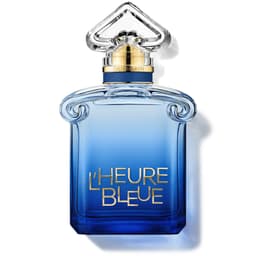
L'Heure Bleue 2026 is an Eau de Parfum by Guerlain composed by Delphine Jelk, which borrows the name of the 1912 classic without borrowing its formula. An ozonic accord opens on pear and neroli, a double iris, custom-made tincture and butter, holds the heart with jasmine, and vanilla closes on ambroxan and musks. The house classifies it as floral amber.
Guerlain declares a pyramid in three stages. At the top, an airy ozonic accord paired with the freshness of pear and neroli. At the heart, an iris tincture custom-created by the house, combined with iris butter and jasmine. At the base, vanilla, ambroxan and musks. The whole is classified as floral amber and the house claims the Guerlinade, its signature base accord, within it. The descriptions published at launch all repeat this same text: their agreement is expected and does not amount to independent verification.
The opening is the point of rupture with 1912. The ozonic accord belongs to the vocabulary of contemporary synthetic perfumery, not to that of the early twentieth century: it produces a cold freshness, somewhat saline and mineral, closer to the air after rain or the seaside than to a flower. Set against pear, which brings a soft, non-acidic fruity flesh, and against neroli, which gives the green, bitter brightness of distilled orange blossom, it establishes a clear, damp and deliberately disembodied entrance.
The heart rests on two forms of the same flower. Iris butter is a concentrate drawn from rhizomes aged several years, whose irones carry that powdery, cold and slightly fleshy facet that perfumery calls the root; it is one of the most expensive raw materials in the trade. The tincture, meanwhile, extracts a more complete material using alcohol, which Guerlain describes as greener and woodier. Their combination is the perfume's argument: an iris that is less pomade-like, less cosmetic, held by jasmine which provides the composition's only genuinely floral relief.
The base is short and legible: vanilla, ambroxan, musks. Ambroxan is an amber molecule, dry and mineral, highly diffusive, which has become in fifteen years the backbone of much of mass-market perfumery; it is what carries the sillage described as addictive, and it is also what brings this base closer to many others. Vanilla ensures the link with the house more than with the original composition. The ingredients list published by Guerlain does list vanillin and a family of tetramethyl acetyloctahydronaphthalenes, synthetic amber woody materials; ambroxan itself does not appear under that name, since a regulatory list only declares substances subject to labeling.
One point deserves mention, because it complicates the launch narrative. The declared pyramid no longer mentions anise, carnation, tonka bean or benzoin, which make up the powdery, candied signature of the 1912 composition. Yet the ingredients list published by the house still lists anethole, an anise marker, and benzaldehyde, an almond marker; it also lists patchouli, rose, ylang-ylang and bergamot essence, of which the official pyramid says nothing. A regulatory list is not a formula: it only declares substances subject to labeling and provides no information on dosages or proportions. It nonetheless prevents any claim that these facets have entirely left the bottle.