
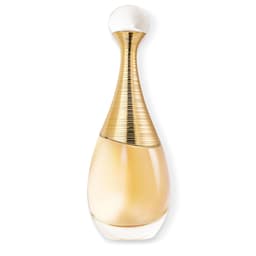
J’adore is the feminine pillar of Dior, launched in 1999 at the instigation of Sabina Belli, the house's international perfume products director, and composed by Calice Becker alongside Ann Gottlieb. This sun-kissed fruity floral, presented in an amphora bottle signed by Hervé Van der Straeten, took the top spot in the French feminine market from Chanel's N°5 in 2010. More than twenty-five years later, it remains Dior's leading feminine reference.
J’adore ranks among the greatest successes in French perfumery. Its luminous, floral scent has won over the hearts of millions of loyal wearers since its release in 1999. Yet J’adore was a bold project, breaking with the Dior house's traditional scents, sometimes classic or even minimalist, sometimes frankly opulent like the famous Poison. Calice Becker managed to compose a fragrance that stayed true to the house's spirit while being carried by a need for optimism and light.
J’adore Eau de Parfum, or Calice Becker's fragrant tribute to Christian Dior
The J’adore project was born at Dior in the late 1990s, at the instigation of Sabina Belli, then the house's international perfume products director. The composition was entrusted to Calice Becker, who worked alongside Ann Gottlieb to define the olfactory project.
Far from a beginner, Calice Becker had already been signing formulas for nearly ten years: she was responsible for the reformulations of Monsieur Balmain and Vent Vert at the turn of the 1990s, and for Tommy Girl in 1996. Dior entrusted an already established perfumer with a fragrance meant to carry an immediate, sun-drenched name.
For J’adore Eau de Parfum, the perfumer sought to translate olfactively the flowers that Christian Dior loved. She modernized them by adding sparkling fruity notes and more sensual depths, so as to hold together both the memory of the house and the taste of its era.
The fragrance's success left a lasting mark on Dior, which released numerous versions of it over the years, making it its feminine pillar. After François Demachy, it is now Francis Kurkdjian, the house's perfumer-creator, who oversees its developments.
J’adore Eau de Parfum, or a love of exceptional raw materials
If J’adore very quickly became a perfumery best-seller, it is thanks to the universal appeal of its luminous composition, but also thanks to the care given to the choice of ingredients.
The floral heart of J’adore is presented by the house as an ode to gardens: ylang-ylang from the Comoros for its exotic sweetness, Turkish Damask rose for its sensual amplitude, and sambac jasmine from India, fruity with a touch of orange blossom, echoed by Grasse jasmine.
This demand for quality raw materials is part of a broader strategy: Parfums Christian Dior owns its own floral fields in the south of France, a distinctive feature that few competitors can claim.
J’adore established itself lastingly in its home market. According to figures from the NPD panel, it took the top spot in the French feminine market from Chanel's N°5 in 2010, which had held it for decades, before widening the gap in 2011 with a 17% rise in sales and 4% of market share.
A pyramid that has changed between 1999 and today
Reference olfactory descriptors report the 1999 composition in the form of a tiered pyramid. Two of them, independent of each other, agree on bergamot and mandarin in the top notes, on jasmine, rose, violet, orchid and plum in the heart, and on musk and blackberry in the base. These are the nine materials carried by the pyramid on this page.
Other notes circulate in descriptions of the original formula without being confirmed by a second independent source: pear, melon, peach, lily of the valley, tuberose, freesia, vanilla and cedar. They are reported here without being carried by the pyramid. A third descriptor, for its part, mentions champaca, amaranth wood and a note of Banyuls wine, and it is the only one to do so.
The house today describes a different composition. On its product page, Dior opens the eau de parfum on ylang-ylang, then places Damask rose and a duo of grandiflorum jasmine and sambac jasmine at the heart. This description repeats neither the fruity top notes nor the base materials cited for 1999. Retailers who repeat it merely reproduce the house's text and therefore do not constitute a separate source. This page retains the cross-referenced pyramid of the original composition and reports here the version that Dior publishes for the juice sold today.