
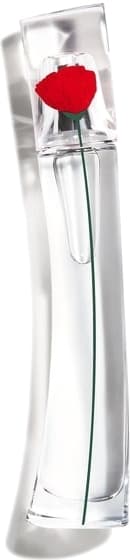
A powdery floral released in 2000, Flower by Kenzo gives a scent to a flower that has none. Alberto Morillas builds his poppy with violet and Bulgarian rose, set on a base of vanilla and white musks. Blackcurrant and pink pepper open the composition, while heliotrope pulls the whole toward old-fashioned lipstick. The bottle, a long tilted glass stem, comes from Serge Mansau, based on an idea from the agency Air Paris.
The disagreement over Flower is not about its success, which almost no one disputes, but about what it is: the most attentive readers refuse to see it as a floral. Here is what the judgments agree on, and what separates them.
Olfastory’s review
Where opinions converge
No one disputes the powdery sensation. Every serious reading recognizes old-fashioned makeup, the lipstick, the rice powder, and the regressive comfort effect that comes with this family of scents.
On the bottle, however, there is no opposing camp. Twenty-five years on, the tilted stem still reads as contemporary, and reviewers readily describe it before even addressing what it contains.
Longevity and sillage are credited to the fragrance even by those who do not like it. The musky, vanilla base stays legible for a long time without turning into fabric softener, which is not so common.
A lineage few write about
The most incisive criticism does not classify Flower among florals but among abstractions. The juice would evoke no particular flower, not even the general idea of a flower: it would be a successful conceptual exercise.
It then links the fragrance to a specific lineage, that of melancholic violet powdery scents descended from L’Heure Bleue. Flower would take its material and texture while leaving behind all of its melancholy.
The shorthand favored by these readers retains the idea of a predecessor stripped of its sadness: same material, same texture, but a fixed light where the other unfolded a narrative. No commercial page offers this reading.
What divides opinion
The most frequent complaint is about talc. Some readers smell only baby powder for several hours, pleasant but flat, and consider the price too high for what the bottle actually delivers.
Overexposure works against it. Worn too often, too widely copied in the mass market, it loses for some the distinctiveness that had made its success, without the formula itself being at fault.
Parma violet does not win unanimous approval either. Its confectionery facet, almost candy-like, comes across as charming or as cloying depending on the season and the skin, and the difference in judgment often comes down to very little.
Questions that remain open
A second signature cannot be confirmed. A second name circulates on major online databases and on retail sites that copy them, but no source outside this chain confirms it, and the house credits only Morillas.
Reformulations cannot be dated. Everyone senses that the juice has shifted over twenty-five years, no one records when or how, and the batch records that circulate do not cover this reference.
The volume sold escapes any verification. The commercial triumph is repeated from page to page without a single figure tracing back to a public record, and an unsourced sales ranking is worth no more than silence.