
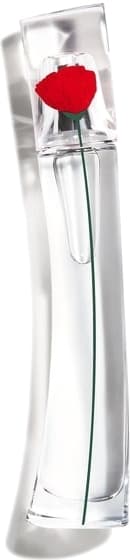
A powdery floral released in 2000, Flower by Kenzo gives a scent to a flower that has none. Alberto Morillas builds his poppy with violet and Bulgarian rose, set on a base of vanilla and white musks. Blackcurrant and pink pepper open the composition, while heliotrope pulls the whole toward old-fashioned lipstick. The bottle, a long tilted glass stem, comes from Serge Mansau, based on an idea from the agency Air Paris.
Flower by Kenzo presents itself as a floral, and is not quite one. The work starts from an odorless flower, which forces the perfumer to invent entirely what he is supposed to render.
The accord of a flower that smells of nothing
Morillas describes his process plainly: two flowers first, violet and Bulgarian rose. The strength of one and the fragility of the other seemed to him, together, to render what a poppy would smell like if it had a smell.
This is not a reconstruction but an invention. No analysis guided the formula, no extract served as a reference, and the result nowhere claims to resemble what one breathes in a field.
The top, and the fruit that is often misread
Mandarin, blackcurrant and pink pepper open the fragrance. Blackcurrant brings a fruity acidity that keeps the rose from immediately turning toward dust, and pink pepper adds a brief spicy touch.
The fruit is often misread in circulating listings, where the blossom of the blackcurrant bush takes the place of the blackcurrant bud. The two materials bear no resemblance to each other, and all sources cite the fruit.
The powdery facet, and where it comes from
Vanilla and white musks hold the base and give the velvety quality Morillas claims. Heliotrope adds its anise-like accents, and this is where the powdery sensation comes from, rather than from the flowers themselves.
Two French critics, who do not cite each other, arrive at the same image: old-fashioned lipstick, rice powder, the scent of makeup from another era. This convergence carries more weight than any published pyramid.
What the house states, according to the bottle
The house describes its Eau de Parfum through pink pepper and Damascena rose, wrapped in vanilla and white musks. For the Eau de Toilette, it names Damascena rose, violet and mandarin.
The two descriptions differ, and violet only appears in the second one. Morillas, for his part, places it at the center of the juice he describes without distinguishing between concentrations. Both accounts stand, and the choice remains open.
What does not appear
Hawthorn, opoponax, carnation and coumarin often come up online. Each is supported by only a single source, when it is supported at all, and none meets the two independent sources of a different nature required for inclusion.
The poppy itself is not a note. No source describes an extract or reconstruction bearing that name in the formula: the flower provides the subject, the image and the bottle, never the material.