
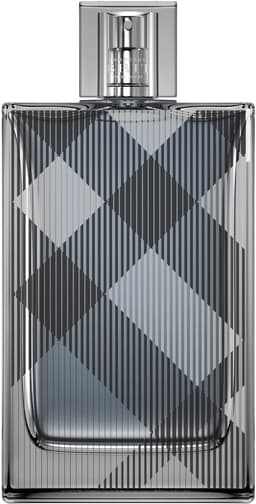
Brit Homme was released in 2004, a year after the feminine of the line. Antoine Maisondieu lays a powdery rose over a bed of cardamom and ginger, running against a masculine decade that ignored the flower. Tonka bean, patchouli and musk hold the base and the nonchalance claimed by the campaign. The juice received a FiFi award in 2005 and became Brit For Him in the mid-2010s.
Brit Homme divides less than it embarrasses. Almost all readers find the same thing in it, a powdery rose, talc and dry spices, and part ways on what to think of it. The disagreement concerns the gender of the juice, not its smell.
Olfastory’s review
Readings of this juice converge in an unusually consistent way. Powdery rose, talc, dry cardamom: the same words recur under pens that do not read one another, and ten years apart.
Talc, and an iris no one else reports
Jeanne Doré wrote in 2007 that the floral accord evokes without ambiguity the smell of baby talc. She reads a blend of iris and rose in it, very cosmetic, and speaks of a marvel of spices, musk and powder.
She places the top note near Déclaration by Cartier and the base near Zino or Habit Rouge. Both comparisons pull the juice toward classic masculines, not toward the perfumery of its own era.
English-speaking readers describe the same thing without naming it the same way: a soapy powder, a softened rose, a dry spice that does not sting. Several picture an older man, groomed for a date.
A masculine that many read as feminine
The disagreement starts there. Doré writes that a woman could wear it without difficulty, so soft and floral is it. Other readings say the opposite: powdery first, but masculine nonetheless, with enough musk and spice to hold the gender.
The debate is far from trivial in 2004. Masculine rose barely existed on the shelves of the time, and a men's perfume built on it had no benchmark to compare itself against.
Those who reject the juice find it too close to a toiletry product, soap or baby powder. Those who love it note exactly the same impression and count it as a quality.
Longevity, the sole constant complaint
The recurring complaint does not concern the smell but its duration. Several readings describe a short sillage and a presence that fades quickly, without the body expected of a masculine in this family.
Other accounts say the opposite and credit it with seven or eight hours in winter. The gap is too wide to come from skin alone, and reformulations of a juice sold for twenty years probably account for part of it.
None of the sources consulted document these reformulations, and none date them. The observation stops there: readings diverge on longevity, and nothing allows one to say which describes which bottle.
What Brit foreshadowed of London
A close reading links this juice to London pour Homme, released two years later by the same hand. Brit carries a grey, powdery rose that London would later take up, doubling it with tea and darker materials.
The kinship is olfactory before it is commercial, and it comes down to the hand that signed both. It explains why the two juices are often confused on the shelf, even though the second is markedly darker.