
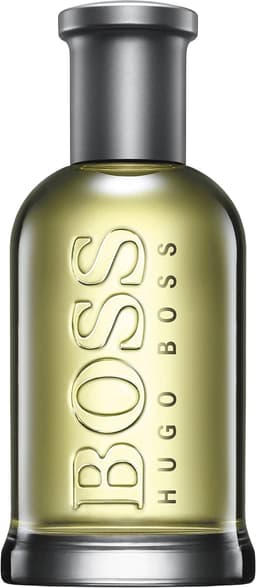
Boss Bottled opens on apple, lemon and plum, warming with cinnamon and clove that geranium accompanies in the heart, before descending toward sandalwood, cedar and vetiver that vanilla comes to soften. Composed by Annick Ménardo for Hugo Boss in 1998, it owes its signature to this vanilla, then unusual in a masculine fragrance. Six faces have embodied it in campaigns, and it remains the house's best seller.
The inventory retained for the 1998 eau de toilette holds in ten names. The fruit opens before the citrus, the spices hold the middle, and the base brings together three woods that a vanilla softens. The whole reads quickly: it is a legible construction, not a puzzle to decipher.
Annick Ménardo, from biochemistry to the bottle
The perfumer first studied medicine, chemistry and biochemistry before going through ISIPCA. She was trained by Michel Almairac at Créations Aromatiques, whose imprint her early work bears, and has worked for Firmenich since 1991.
In that same year, 1998, she signs Hypnotic Poison for Dior. Two fragrances with nothing in common on the shelf—an office masculine, an almond and vanilla feminine—come out of the same hand within twelve months.
Her catalog does not fit neatly into one category: Lolita Lempicka Au Masculin, Body Kouros at Yves Saint Laurent, Black at Bulgari, Bois d'Argent at Dior, Gaiac 10 and Patchouli 24 at Le Labo, Bois d'Arménie at Guerlain.
A second signature, Christian Dussoulier, appears in an entire family of online records. Neither the house nor the encyclopedic entry devoted to the perfumer mentions it. The contradiction is noted here rather than resolved.
Geranium, in the heart rather than in the top
Its placement varies by inventory. The house's press kit places it in the heart, with cinnamon and clove; a widely copied community database ranks it in the top. An independent British review puts it back in the heart.
What it does, however, does not vary. Its green and rosy facet keeps the fruity trio from tipping into confectionery, and gives the fragrance's middle the discreet flower that keeps it away from a dry woody feel.
Cinnamon occupies the rest. It warms without burning, at a dose that makes it recognizable without making it overpowering: it is this, along with apple, that most people recall when describing it from memory.
A spice that inventories name in two ways
At the same spot, English-language records write either carnation or clove. The house writes clove. Eugenol shows up in both, which explains the confusion without quite excusing it.
Clove is retained, carnation set aside. The difference is not cosmetic: one is a spicy flower, the other a straightforward spice, and the fragrance's middle is not told the same way depending on which one is placed there.
The base brings together sandalwood, cedar and vetiver. The three woods answer one another: sandalwood brings milk and softness, cedar the dryness of pencil shavings, vetiver a slightly smoky earthiness that keeps the whole from dozing off.
Vanilla anchors the base. It is not there to sweeten but to bind: the house describes it as a setting that showcases the other materials, and that is how it acts, rounding out the woods without covering them.
What the lists add without anything to support it
Five materials recur everywhere online: oakmoss, mahogany, carnation, olive tree, bergamot. They come from a single inventory, copied from site to site without anything changing, which multiplies the pages without multiplying what grounds them.
Cardamom is indeed attested, but elsewhere. It belongs to the eau de parfum released in 2020, where it sits alongside black pepper and chestnut. Tracing it back to the eau de toilette amounts to mixing up two distinct formulas.
Lavender comes from another slippage: a more recent limited edition makes it its main argument. Pink pepper, dihydromyrcenol, nutmeg and coumarin, meanwhile, rest on nothing verifiable and fall outside the inventory.
Ten names remain, which is few for a fragrance of this renown and a lot for what can be established. A short, reliable list is worth more than a long one that contradicts itself from one page to the next.