
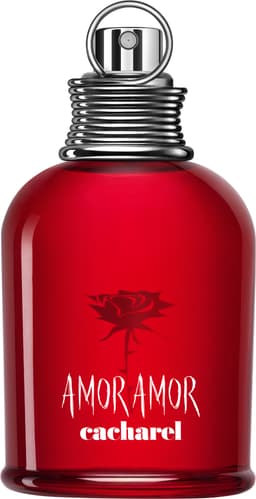
Amor Amor was released in 2003, composed for Cacharel by Dominique Ropion and Laurent Bruyère, both then at IFF. A fruity floral whose citrus and blackcurrant opening makes it immediately mouthwatering, followed by a discreet rose and a vanilla base where amber and sandalwood surface. Its red bottle with a metal stem made it a lasting Valentine's Day gift, and critics, initially reluctant, came to acknowledge its genuine structural staying power.
Initially rejected over its campaign, Amor Amor won over critics through its construction. Bois de Jasmin ranks it among the pinnacles of fruity floral, while wearers debate its longevity and suspect a reformulation that the house does not document.
Olfastory’s review
Amor Amor causes little disagreement over what it is, much more over what it is worth. Twenty years after its release, specialized critics and wearers agree on its construction and diverge on the place it deserves.
A critical reception initially hostile
The first review published by Auparfum, in 2006, amounts to rejection. The advertising campaign and the teenage positioning are called kitsch there, and the fragrance is dismissed outright as a mass-market item.
The second reading shifts tone, over the course of several trials. Amor Amor gains construction qualities there, both commercial and creative, and a balance that nothing in its advertising presentation had suggested.
This trajectory is instructive. Amor Amor suffered from its image before being smelled, and the gap between the advertising discourse and the juice long clouded its evaluation by enthusiasts.
What critics acknowledge in it
Bois de Jasmin goes further and names it the best fruity floral of the genre, embracing the excess of such a claim. The argument rests on the longevity of the whole rather than on the originality of any single raw material.
The same source notes that the fragrance overflows its family. Vanilla, sandalwood and amber pull it toward oriental, which explains the conflicting classifications found from one site to another.
The recurring image is that of a fragrance both simple and carefully crafted, capable of pleasing immediately without being sloppy. This dual character has earned it twenty years of shelf presence.
What wearers report
On longevity, feedback converges around four to five hours for the eau de toilette, with sillage judged moderate. Several wearers regret a rapid evaporation of the top notes.
In terms of use, the fragrance remains associated with a first bottle received as a gift, in adolescence or at twenty. This emotional charge comes up constantly and weighs on judgments, in both directions.
A recurring reservation concerns sweetness, judged overwhelming by those who wear it during the day and apply it generously. Several accounts suggest that dosage matters more here than with other formulas.
What remains unsettled
Doubt about the current formula runs through specialized forums as well as comments published on Auparfum. Those who repurchase the bottle after years describe a softened juice, without any official source confirming or contradicting this observation.
Two explanations coexist without one being decisively favored: the evolution of formulas under regulatory constraint, and the shift in taste and smell with age. Both are plausible, neither is demonstrated here.