
Million Gold for Her Pure Diamonds
Million Gold For Her Pure Diamonds: diamond fever takes hold of the golden bottle. In a contemporary perfumery where every launch must generate immediate buzz, Rabanne has deployed since 2024 a strategy that fascinates as much as it raises questions: the accelerated multiplication of flankers around a single concept. Million Gold For Her Pure Diamonds, launched in January 2026, arrives as the fourth variation in eighteen months — a sustained pace that makes the Million Gold For Her collection a textbook case of what marketers call line extension, and one the community openly debates.
- Brand
- Paco Rabanne
- Launch year
- 2026
- Gender
- Women
- Olfactory family
- Oriental
- Secondary family
- Floral
- Concentration
- Eau de Parfum
Where to buy
The timeline speaks for itself: Million Gold For Her in April 2024 established the territory with its sugared pear and creamy ylang-ylang; Pure Jasmine in February 2025 refined the formula around a luminous mono-floral; Parfum in October 2025 intensified the concentration; and now Pure Diamonds in January 2026 promises to capture the essence of glittering success through a velvety peach and sparkling florals. Four fragrances in eighteen months — an average of one new flanker every four and a half months — a pace that defies all the traditional conventions of perfumery, where developing and launching a line extension once took several years.
Diamond rush: from Kimberley to perfumery, the history of a contagious fever
The term diamond rush chosen by Rabanne to describe this limited edition is not incidental: it directly evokes the great rushes for precious stones that marked modern economic history. The Kimberley diamond rush in South Africa (1871), where thousands of prospectors converged on the mines hoping to make their fortune, the Klondike gold rush in the Canadian Yukon (1896-1899), which saw 100,000 people try their luck in the frozen rivers, or the legendary Golconda diamond mines in India, which for centuries fed the treasures of maharajas — an imagery of sudden fortune and mineral abundance that the name of this edition deliberately conjures.
Transposed into the register of commercial perfumery, this diamond rush metaphor takes on a troubling meaning: Rabanne seems to be telling us explicitly that there is a Million Gold vein to be mined for as long as it shines, for as long as consumers keep flocking in, for as long as the name still generates desire. The strategy is no longer to patiently build a coherent lineage over ten years but to saturate the market for eighteen months with every possible variation before attention shifts to the next concept. This is the pure application of the fast-fashion model to perfumery: produce quickly, multiply variations, create purchasing urgency (limited edition! only 50 ml and 90 ml! hurry!), then move on to the next concept once this one runs out of steam.
The diamond as the absolute marketing signifier of ostentatious luxury
Why the diamond? Because as a cultural signifier, the diamond occupies a unique position in the collective imagination of luxury: it is the hardest naturally known material, hence a symbol of eternity and indestructibility; it is the most expensive precious stone per carat, hence the ultimate marker of wealth; it has been the central object of the Western engagement ritual since De Beers's brilliant marketing campaign A diamond is forever (1948), hence a vehicle for a capitalized romanticism; it is the element that turns light into a rainbow through refraction, hence the embodiment of pure sparkle and brilliance.
In the marketing vocabulary of perfumery, invoking the diamond amounts to invoking all these values simultaneously: luxury, eternity, preciousness, brilliance, absolute desirability. This is why the diamond appears everywhere in the names and visuals of mainstream feminine fragrances — from Bright Crystal by Versace to Crystal Noir by the same house, from Diamonds by Armani to Lady Million and Million Gold by Rabanne. The diamond has become the universal catch-all word that promises the consumer that by buying this bottle, they symbolically acquire a fragment of this unalterable mineral luxury — the symbol of eternity attached to a product that is, by nature, ephemeral.
Scarcity marketing and FOMO: the limited edition as psychological lever
Million Gold For Her Pure Diamonds is not presented as a permanent addition to the range but as a limited edition — a status that immediately activates a powerful psychological lever: artificial scarcity. In behavioral science, the scarcity principle demonstrates that we place greater value on what is, or seems to be becoming, rare. An identical product will be perceived as more desirable if presented as limited quantities or special edition than if it is permanently in stock — even though the reality of this limitation is often quite relative (productions of tens of thousands of bottles labeled limited editions).
This artificial scarcity also activates FOMO (Fear Of Missing Out), particularly prevalent in the age of social media: if I do not buy this limited edition Pure Diamonds now, it will disappear and I will regret not having it in my collection. This consumerist anxiety is all the more effective as it targets collectors who actively follow fragrance launches: women who already own the original Million Gold For Her, perhaps Pure Jasmine, possibly Parfum, and who feel this compulsive need to complete the collection even if the olfactory differences between the versions are sometimes slight. The collection becomes an end in itself, regardless of actual usefulness (how many bottles can one person reasonably finish in a lifetime?).
Sixty carats of heritage: Rabanne, goldsmith of metal and mineral since 1966
If Million Gold For Her Pure Diamonds presents itself as a tribute to the house's 60 years of diamond expertise, it must first be recalled that Paco Rabanne (real name Francisco Rabaneda Cuervo) was never a jeweler in the strict sense, but a revolutionary fashion designer who built his legend precisely on the use of non-textile materials — metal, plastic, paper — to construct garments. Understanding this claimed lineage between the armor-dresses of 1966 and this 2026 fragrance requires a detour through the extraordinary history of this house, which transformed aluminum discs and chainmail rings into icons of haute couture.
1966: Twelve Unwearable Dresses, or the revolution of industrial materials
In February 1966, Paco Rabanne — then thirty-two years old and already experienced as a designer of plastic accessories for other houses — presented at the Hôtel George V in Paris a collection that would forever define his creative identity: Manifesto: 12 Unwearable Dresses in Contemporary Materials. The title itself is a manifesto: these dresses are not made to be worn comfortably in the traditional sense; they are bodily art objects, wearable sculptures that favor radical aesthetics over bourgeois practicality.
The dresses are composed of rhodoid (plastic) discs or aluminum plates linked together not by seams but by metal rings — exactly the technique of medieval chainmail transposed to the materials of the industrial era. Rabanne, who had studied architecture at the École des Beaux-Arts in Paris before turning to fashion, applied to his creations a logic of architectural assembly rather than textile-making: each disc or plate was an independent module, each ring a joint, the whole creating a structure that was flexible yet rigid, sonorous (the metal discs jingled with the slightest movement), and visually stunning — as if warriors from the future were wearing armor of light.
The French press immediately nicknamed Rabanne the enfant terrible of Parisian fashion, while Women's Wear Daily wrote that his designs resembled Valkyries or miniature citizens of Sparta — belligerent references that underscored the paradox of these creations: hyper-feminine dresses in their short, fitted form, but paradoxically masculine or even militaristic in their metallic materiality and evocation of combat armor. This duality — softness of form, hardness of material — would become the philosophical signature of the entire house.
Françoise Hardy and the 300-carat dress: when the diamond becomes literal
The height of this fascination with precious materials came in 1968 when Paco Rabanne created for French singer Françoise Hardy what was then called the most expensive dress in the world: a creation composed of a thousand gold plates (totaling nearly thirty-eight kilograms of precious metal!) assembled using the usual ring technique, with a collar set with three hundred carats of diamonds. Three hundred carats — for perspective, the famous Koh-i-Noor diamond of the British Crown weighs 105 carats. This dress-jewel literally embodied the concept of the worn diamond that Pure Diamonds now seeks to evoke metaphorically.
Françoise Hardy, a yéyé icon with a melancholic, androgynous beauty, wearing this armor of gold and diamonds weighing nearly forty kilos, created an unforgettable image: that of a feminine fragility protected/imprisoned by a shell of mineral wealth. The photograph showing her in this dress — unable to move freely under the crushing weight, yet magnificently sculptural, a true living golden statue — sums up the entire ambiguity of ostentatious luxury: is it an adornment or a shackle? An ornament or a burden? A celebration of beauty or a reification of the female body turned into a walking safe?
From chainmail dress to polygonal bottles: the persistence of a geometric aesthetic
What links the disc-dresses of 1966 to the Million bottles of 2008 and then Million Gold of 2024 is the permanence of a geometric, mineral, architectural aesthetic that rejects textile softness in favor of crystalline angularity. The Million bottles (masculine, then feminine) take the form of a gold ingot cut into facets like a rough diamond — each flat face reflecting light differently, creating the sparkling effect that simultaneously evokes the cut diamond and the metal discs of the historic dresses.
This visual continuity between the fashion creations and the fragrance bottles creates remarkable brand coherence: by owning a Million Gold fragrance, one symbolically owns a fragment of this Rabanne heritage, a portable miniature of these sculpture-dresses that revolutionized fashion. The bottle thus becomes much more than a simple functional container: it is an object of desire in itself, a precious trinket displayed on a dresser exactly as one would display a piece of jewelry — and this decorative dimension of the bottle alone justifies, for many consumers, the repeated purchase of flankers that are nearly identical olfactorily but different visually (change of liquid color, variation in gold finishes, and so on).
Peach velvet and floral brilliance: dissecting a strategically calibrated formula
Let us now move from marketing mythology to olfactory reality: what exactly does the Pure Diamonds bottle contain, and how does it differ — or not — from its Million Gold predecessors? The announced pyramid is deliberately streamlined, almost minimalist compared to the original Million Gold For Her, which played on seven notes (pear, rose, lavender, ylang-ylang, jasmine, vanilla, musk, moss). Pure Diamonds focuses on only six listed ingredients: velvety peach and bergamot on top, ylang-ylang and jasmine at heart, vanilla and sensual musk at base. This reduction suggests a desire for clarity, for limpidity — exactly what one expects from a pure diamond that lets light pass through without opaque inclusions.
Velvety peach versus classic peach: marketing rhetoric or chemical reality?
The mention of velvet peach rather than simply peach deserves attention. Is it merely marketing inflation — dressing up a note's name to make it seem more precious — or is there an olfactory reality behind this qualification? In perfumery, peach is systematically reconstructed synthetically, as the fruit itself cannot be effectively distilled or extracted (too much water, not enough concentrated essential oils). Perfumers use lactones — cyclic molecules that create the fruity-creamy-milky odors typical of stone fruits.
Gamma-undecalactone and delta-decalactone are the two star lactones of peach reconstruction: the first brings creamy roundness and an almost milky sweetness (it is the one found massively in sweet gourmand fragrances such as La Vie Est Belle), the second adds juiciness and a slight green acidity reminiscent of fresh peach skin. When Rabanne describes its peach as velvety, one can assume it is a creamier rather than juicier peach, with a dosage favoring gamma-undecalactone and perhaps the addition of musks to create this soft, silky, caressing olfactory texture — exactly as velvet fabric caresses the skin without roughness.
This velvety peach stands in conceptual opposition to the watery-juicy peach found in certain fresh summer fragrances (think of Aqua Allegoria Pera Granita by Guerlain, which plays on the icy juiciness of the fruit). Here, Rabanne clearly aims for comfort, envelopment, that sensation of immediate softness that reassures and seduces without aggression. It is an indoor, cushioned peach rather than an orchard peach in the sun — consistent with the luxurious positioning and the diamond imagery that evokes the velvet cases in which precious jewels are presented.
Sparkling bergamot: citrus as a source of olfactory brilliance
Against this velvety, enveloping peach, bergamot provides the necessary counterpoint of freshness and, above all, brilliance. Bergamot — the quintessential Calabrian citrus whose essential oil is extracted from the zest by cold pressing — has that magical quality of smelling simultaneously fresh, sparkling, clean, and slightly bitter-green. It is the ingredient that opens a fragrance, giving it its initial spark, its first impression of luminosity.
In the context of Pure Diamonds, bergamot is probably not used for its Earl Grey tea facet (bergamot plus lavender) nor for its classic cologne dimension (bergamot plus neroli plus rosemary), but rather for the effect perfumers call sparkling. The limonene and linalool naturally present in bergamot essential oil create this impression of olfactory effervescence, of micro-bubbles rising to the nose exactly like the bubbles of champagne. This pairing of velvety peach and sparkling bergamot creates a balance between softness and vivacity, between plushness and brilliance — a balance that olfactorily translates the concept of the diamond: a hard stone that nonetheless captures and reflects light in a thousand sparkling facets.
Creamy ylang-ylang and radiant jasmine: the floral duo of opulent femininity
At the heart of the composition, ylang-ylang and jasmine form the classic white floral pairing of any feminine perfumery aiming for sensuality and luxury. Ylang-ylang (Cananga odorata, a tropical tree native to Southeast Asia) yields an essential oil extraordinarily rich in esters that give it its creamy, narcotic, slightly animalic character, with banana-coconut-vanilla facets depending on the distillation fraction (extra, I, II, III, complete).
In mainstream commercial fragrances, the extra or first fractions are generally used, being the finest, the least dirty, the most immediately appealing. Ylang-ylang brings a floral-fruity creaminess that envelops and warms — it is what gives contemporary white florals that almost edible texture, that floral gourmand quality that distinguishes them from classic, drier, more powdery florals such as Chanel N°5. Chemically, this creaminess largely comes from para-cresyl methyl ether, an aromatic molecule that smells simultaneously floral, balsamic, and vaguely vanillic.
Jasmine comes to brighten this ylang creaminess by bringing its characteristic radiance. The jasmine used in modern perfumery is either jasmine grandiflorum absolute (Grasse) or jasmine sambac (India), or a synthetic jasmine accord reconstructed with hedione (a Firmenich molecule that smells airy, transparent, almost aquatic jasmine) and jasmine lactone for roundness. In Pure Diamonds, the jasmine is described as radiant, which suggests that the luminous facets are favored over the indolic-animalic facets of natural jasmine. It is a jasmine of light rather than a jasmine of night, a jasmine that sparkles rather than one that unsettles.
Creamy vanilla and sensual musk: the comfort foundation of every blockbuster
As in 95 percent of commercial feminine fragrances launched over the past twenty years, Pure Diamonds rests at base on the reassuring vanilla-musk duo that guarantees mass acceptability, a sense of comfort, that impression that it smells good without provoking or disturbing. This pairing has become the universal olfactory code for desirable femininity in mainstream Western perfumery — to the point that one could almost speak of standardization: whether one buys a Lancôme, a Yves Saint Laurent, a Paco Rabanne, or a Cacharel, one will inevitably find this vanilla-musk base rendered with slight variations.
The vanilla used is obviously not the costly extract of Bourbon vanilla pods (reserved for high-end niche fragrances) but a synthetic reconstruction based on ethylvanillin or vanillin, molecules that smell gourmand-vanilla in a much more intense and less complex way than the natural absolute. This synthetic vanilla brings creamy sweetness, a slightly sugary-powdery side, that olfactory sensation of a comforting hug that immediately pleases and reassures.
The musk described as sensual is necessarily synthetic (animal-derived musks being banned), probably a blend of modern polycyclic musks (Galaxolide, Celestolide, Tonalide) that create that clean-soft-bare-skin impression characteristic of contemporary musk. These synthetic musks no longer have much to do with the animal musk historically used: where natural musk was animalic, fecal, unsettling, modern musks are clean, tame, consensual — they smell of high-end laundry detergent, freshly ironed cotton, skin after a shower with a luxury soap. When Rabanne describes its musk as sensual, one should understand domesticated sensuality, sweetened eroticism, nothing that could offend or disturb — the acceptable sensuality for a fragrance aiming for millions of bottles sold.
The polygon case: visual metamorphosis of the golden ingot
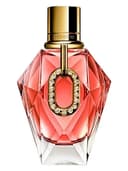
The Million Gold For Her Pure Diamonds bottle retains the iconic silhouette established by Lady Million in 2010 and then declined across all later versions: this multifaceted gold ingot, this cut-rough-diamond geometry that turns the bottle into a miniature jewel. But each flanker brings its own color variations and finishes that distinguish it visually from its predecessors on the perfume counter shelf or in the bathroom — an essential distinction since a significant part of the perceived value lies in the object itself rather than in its liquid content.
Geometry of desire: facets, angles, and light refraction
The shape of the Million bottle deserves attention, as it perfectly embodies what designers call object desire — the object that arouses desire through its mere visual presence. Unlike classic cylindrical bottles (such as N°5 by Chanel) or curved organic shapes (such as Jean Paul Gaultier and its female torso), the Million bottle is pure angular geometry: planes, sharp edges, facets meeting at acute angles exactly as on a brilliant-cut diamond.
This geometry is not merely decorative: it is functional in its ability to capture and reflect light. Each facet acts as a mirror reflecting ambient light in a different direction, creating that sparkling effect, that bling to borrow hip-hop vocabulary, which makes the bottle catch the eye even from a distance. In a store where hundreds of bottles line up, it is the one that shines the brightest that captures attention first — a Darwinian principle of commercial survival in which visual ostentation determines the consumer's selection.
The glass itself, in Pure Diamonds, probably plays on transparency and coloring effects that amplify this impression of a liquid precious stone. Previous versions of Million Gold oscillated between champagne gold (liquid and glass tinted in pale gold tones), intense gold (bright, almost orange gold), and transparent crystal with golden highlights. Pure Diamonds suggests, in its very name, a desire for transparency, for crystalline purity — one can therefore assume that the liquid and/or the glass play on diamond-like clarity effects rather than golden opacity, creating the illusion of looking through a liquid diamond.
The gold finish: between classic yellow gold and rosé champagne
The gold finish — whether applied to the cap, engraved on the glass, or present as a metallic ring around the bottle neck — is the main identifying element of the entire Million Gold range. But not all golds are equal, and the precise choice of gold shade subtly communicates different values. Classic yellow gold (idealized 24-carat) evokes traditional wealth, the ancestral treasure, the Swiss bank vault; rose gold evokes contemporary jewelry, feminine luxury, fashionable engagement rings; white-platinum gold evokes modernity, refinement, luxurious minimalism; champagne (very pale gold tending toward golden beige) evokes celebration, festive sparkle, joyful luxury.
Without having the bottle physically in hand, one can assume that Pure Diamonds opts for a relatively light gold — perhaps this golden champagne that bridges the velvety peach of the juice (a peach-apricot colored fruit) and the diamond concept (a transparent stone that captures all the colors of the rainbow). This lighter gold shade also allows for visual differentiation from the original Million Gold For Her, which probably played on a more saturated, more assertive gold — the collection thus progresses visually from intense gold toward luminous transparency, from the solid gold ingot toward the pure diamond.
Limited edition: when scarcity is displayed in the design
Limited editions in perfumery often carry specific visual markers signaling their special status: a limited edition seal, numbering, a signature, different packaging (a special case, a more elaborate cardboard box), or additional decorative elements. These markers serve several functions: first, to reassure the buyer of the genuinely limited nature of their purchase (one does not want to buy a limited edition that turns out to have been produced in millions of units); second, to create collection value (the bottle could theoretically be resold at a higher price in a few years as a collector's item); and finally, to justify a price sometimes slightly higher than the standard version.
For Pure Diamonds, the limited-edition status probably manifests in the packaging (a box explicitly mentioning the limited nature, perhaps with a specific visual around the diamond theme — flashes of light, geometric facets, crystals) and perhaps in a slightly different finish of the bottle itself. Offering only two sizes (50 ml and 90 ml) rather than the usual full range (30 ml, 50 ml, 80 ml, 100 ml) also confirms this limitation strategy: by restricting available sizes, an impression of scarcity is artificially created while optimizing production costs (fewer references means economies of scale on the two sizes produced).
Sociology of collectors: who buys the fourth flanker?
Who are the women who, having potentially already bought the original Million Gold For Her in 2024, Pure Jasmine in 2025, and Parfum in 2025, will nonetheless acquire Pure Diamonds in 2026? This question is not trivial, as it touches on the core of a fascinating contemporary consumption phenomenon: compulsive collecting in a field (perfumery) where collecting has no practical rationality, since no one can physically use dozens of bottles before they oxidize and lose their quality.
The completist collector: the neurosis of the incomplete series
The first profile is that of the completist collector — the consumer who feels a form of anxiety at the idea of owning an incomplete collection. Psychologically, this behavior resembles what cognitive scientists call completion anxiety: the mental tension created by an unfinished series, exactly like the reader who cannot bear to leave a book saga unfinished or the philatelist who cannot sleep knowing a stamp is missing from their series.
For this consumer, owning Million Gold For Her 1, 2, and 3 but not 4 creates a void, an imperfection, a lack that can only be filled through purchase. It matters little that the olfactory differences between versions are subtle (peach versus pear on opening, presence or absence of lavender, nuances in the floral balance) — what matters is the symbolic completeness of the series, the harmonious alignment of the four golden bottles on the shelf forming a coherent whole, a reunited family. This consumer is the absolute dream of marketing teams: she is pre-sold on every new flanker as soon as its existence is announced.
The occasional buyer seduced by the diamond concept
The second profile, probably more numerous statistically, is the occasional buyer who owns no other Million Gold but is specifically seduced by the Pure Diamonds concept. This woman is not particularly interested in the coherence of the range or the history of the line — she sees a golden bottle that sparkles, she reads Pure Diamonds and limited edition, she smells a pleasant, consensual velvety peach, she finds the price acceptable (probably around €70-90 for the 50 ml, the standard range for designer feminine fragrances), and she buys it.
For her, Pure Diamonds is not the fourth installment of a saga but a standalone fragrance whose diamond concept resonates personally: perhaps because she is getting married soon and the diamond evokes the engagement ring; perhaps because she likes materials that sparkle and she likes the name; perhaps simply because she was looking for a fruity-floral-vanilla fragrance in this price range and this one perfectly fits the bill. This buyer makes up the bulk of sales and economically justifies the multiplication of flankers: by creating four different versions of Million Gold, Rabanne multiplies the entry points into the brand's universe and maximizes the chances that at least one version will seduce each potential consumer.
The gift recipient: when the limited edition justifies the offering
The third significant profile is the gift recipient — a woman who does not buy Pure Diamonds for herself but receives it as a gift from a loved one (partner, parent, friend) on the occasion of an event (birthday, Christmas, Valentine's Day, Mother's Day). In the economy of the fragrance gift, limited editions occupy a strategic place because they resolve the giver's anxiety: how can one be sure to please by giving a fragrance when olfactory tastes are so personal?
The limited edition provides several psychological solutions: first, it signals I made an effort, I did not just buy any fragrance from the permanent range but a special, exclusive version; second, it guarantees that the recipient probably does not already own exactly this fragrance since it has just been released and is limited; finally, it confers on the gift a superior symbolic value (limited edition sounds more prestigious than standard version). Rabanne's marketing clearly understood this by launching Pure Diamonds in January — ideal timing for Valentine's Day (February 14), when feminine fragrances are traditionally among the most popular gifts.
Performance versus packaging: where does the real value lie for the consumer?
One final question deserves to be asked frankly: for buyers of Pure Diamonds, what truly justifies the purchase — the olfactory quality of the juice, or the bottle-object and the entire symbolic universe (diamond, gold, luxury, limited edition) surrounding it? Consumer reviews published on previous versions of Million Gold reveal a recurring criticism: performance (longevity, projection) is disappointing relative to the price and the luxurious positioning. Several testers mention a lifespan of 4-6 hours maximum, intimate projection (a radius of 30-50cm), and a gradual disappearance that ultimately leaves only the generic vanilla-musk base.
This criticism of performance suggests that for many buyers, the real value of the product does not actually lie in its intrinsic olfactory qualities but in the overall experience of ownership: the pleasure of opening the box, holding the heavy, cool bottle in one's palm, watching it sparkle on the bathroom shelf, showing off the collection to a friend, posting a photo on Instagram with the hashtag #MillionGoldPureDiamonds, participating in this virtual community of luxury fragrance owners. The fragrance then becomes less a liquid worn on the skin than a precious decorative object and an identity marker to be displayed.
This reality explains why Rabanne can afford to multiply flankers at this pace: as long as the bottle remains visually desirable and the price remains affordable for the upper middle class, consumers will keep buying even if the olfactory differences between versions are minimal. Contemporary designer perfumery is no longer merely a trade in scents but a trade in symbolic objects that allow each person to buy an accessible fragment of luxury — a fragment that can be collected, displayed, photographed, exactly as one would collect luxury jewelry if one had the financial means. The €80 golden bottle is to the real €8,000 diamond what the democratized luxury of today is to the aristocracy of the Ancien Régime: an accessible imitation that allows the greatest number of people to take part in the theater of luxury.
The fourth installment in eighteen months of the Million Gold universe, Pure Diamonds embodies both the strength and the limits of the contemporary commercial strategy in designer perfumery: the ability to quickly occupy a market with variations on a single concept, the talent for creating desire around visually attractive bottle-objects, the cleverness of tying each launch to a strong symbolic narrative (here, Rabanne's 60 years of diamond heritage), but also the risk of exhausting the concept and wearing down consumers under this density of flankers. By pairing velvety peach with sparkling bergamot, creamy ylang-ylang with radiant jasmine, sweet vanilla with consensual musk on a polygonal bottle that captures and diffracts light, Rabanne composes less a revolutionary fragrance than a commercial product calibrated to seduce on a massive scale — which is already no small feat in an age of hyperchoice where hundreds of new fragrances are launched every year. What remains is the question posed by any pace of this kind: will the line manage to sustain desire over time, or will fatigue set in among consumers who are already heavily solicited? The next launches will tell.
Olfactory pyramid
Share your impressions
Create an account to keep your votes and find your notebook.