
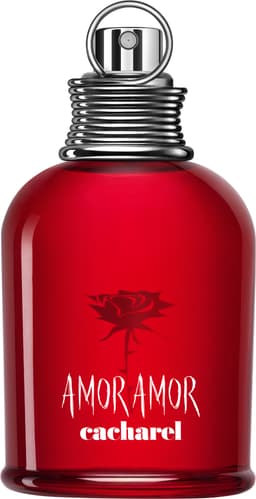
Amor Amor was released in 2003, composed for Cacharel by Dominique Ropion and Laurent Bruyère, both then at IFF. A fruity floral whose citrus and blackcurrant opening makes it immediately mouthwatering, followed by a discreet rose and a vanilla base where amber and sandalwood surface. Its red bottle with a metal stem made it a lasting Valentine's Day gift, and critics, initially reluctant, came to acknowledge its genuine structural staying power.
Amor Amor carries, in our record, four top notes, three heart notes and three base notes. Each is confirmed by at least two independent sources, the others having been dropped for lack of a second witness.
A citrus opening that blackcurrant tips over
Mandarin, grapefruit and orange open the fragrance. The brand specifies a pink grapefruit and a blood orange, two varieties sweeter and rounder than their common counterparts, which orients the opening toward the fruit rather than the peel from the start.
Blackcurrant accompanies them. We had placed it among the heart notes; the community database and the review by Nez place it in the top, where it provides the green acidity that keeps the citrus from turning syrupy.
A brief heart, and a note wrongly carried until now
Rose holds the center, but discreetly. The review published by Nez describes it as a subdued floral, which is confirmed by the secondary place it occupies in the community database's listings.
Apricot takes second place, and it corrects a long-standing error. Our record carried a peach that none of the four sources consulted mentions, whereas our own editorial content already spoke of apricot pulp. The contradiction is resolved in favor of apricot.
Jasmine completes the tier. The brand names it explicitly, as does the community database; some older communications specify a sambac jasmine, but this detail is carried by only one source and is not retained.
A base that pulls the fragrance toward amber
Vanilla dominates, and all four sources attest to it. It gives the fragrance the sweet signature recognizable from a distance, and explains the gourmand label that critics have readily attached to it since its release.
Sandalwood and amber accompany it. Bois de Jasmin cites them as the materials that tip Amor Amor toward oriental; the review by Nez finds this sandalwood in a base it describes as vanillic and milky.
Eleven notes dropped, and the reason for each
Bergamot, cassia, lily, lily of the valley, tonka bean, musk and Virginia cedar are carried only by the community database and its copies. A single source is not enough: they are dropped from the record, without this asserting their absence from the juice.
Raspberry, red apple and a milky note come from a single review, that of Nez. These are tasting impressions, valuable for description, insufficient to establish a raw material. Ambergris falls into the same category, carried by an isolated communication.
Grenadine deserves a separate note. It is often cited as a raw material of Amor Amor, including in our own former editorial content. Nez describes it as an effect, an impression of red syrup produced by the blending of fruits.
The distinction is not a minor detail. An impression is described in prose, a raw material is entered in the record, and conflating the two amounts to inventing an ingredient. Olfastory's reference database, moreover, carries no grenadine.