
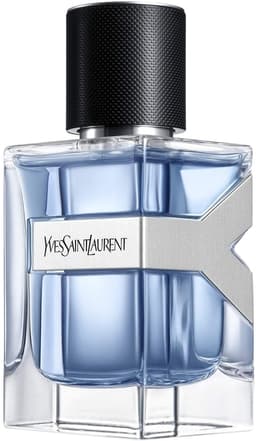
Y Eau de Toilette by Yves Saint Laurent is the masculine fougère that opened the Y range in 2017, composed by Dominique Ropion and crowned best new men's fragrance at the FiFi Awards 2018. Rewritten in 2022 in a blue juice, it pits lavender and clary sage from Provence against a Madagascar geranium, over a base of ambergris, incense and cedar.
Yves Saint Laurent classes Y Eau de Toilette in the fougère family, at the absolute of geranium, and describes it as a mineral, woody fougère. The opening combines bergamot, aldehydes and ginger, a trio already present in the 2017 version and kept in that of 2022.
Lavender and clary sage from Provence
The heart lies in the tension between lavender and clary sage, both grown in Provence, faceted by a bourbon geranium from Madagascar. The house presents these three raw materials as developed for it and lists the lavender essence and geranium heart among its signature ingredients.
The base brings together ambergris, incense and sensual woods, including a cedar essence. It gives the fragrance its longevity, which the brand puts at twelve hours, and the dark facet that answers the freshness of the opening, in keeping with the light-and-shadow fougère logic dear to the range.
The 2017 version
The first Y Eau de Toilette, discontinued in 2022, leaned more toward woody fougère than lavender. Wikiparfum describes it through bergamot, aldehydes and ginger, geranium, cedar and fir, ambergris and incense, a resinous facet that the rewrite abandons.
What remains outside the declared accord
Violet leaf, musk and Tolu balsam, sometimes attributed to the 2017 version, appear neither at the house nor at Wikiparfum. The apple, pineapple, lemon and mint occasionally mentioned appear in none of the brand's discourse.
What the label declares
The house's ingredients list carries, behind alcohol, the word Parfum and water, limonene and linalool, citrus and lavender molecules, as well as ethylhexyl salicylate and butyl methoxydibenzoylmethane, two UV filters that protect the color of the juice.
Then come alpha-isomethyl ionone, a violet, powdery facet, citral, citronellol and geraniol, citrusy and rosy molecules from the geranium, and coumarin, the hay and tonka bean accent of every fougère. Four colorants close the list and give the juice its blue.