
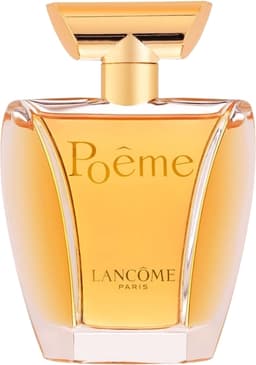
Launched by Lancôme in 1995 and signed by Jacques Cavallier, Poême sets out to “say it all without a word.” The house describes it as a fragrance of shadow and light: the frosty Himalayan blue poppy answers the opulent, carnal datura flower, among white and yellow blooms, orange blossom, mimosa, jasmine. A vanilla base rounds it out. Juliette Binoche was its face from 1995 to 2000.
Lancôme describes Poême as an oriental fragrance of shadow and light, built on contrasts: notes that are frosty or sunlit, blue or yellow, nervous or nonchalant. Wikiparfum places it among the florals with an amber nuance, in the classic line of floral orientals.
Top, heart, and base
The house now lists its notes as follows: at the top, Himalayan blue poppy and lychee blossom; in the heart, orange blossom, mimosa, and jasmine; in the base, vanilla and datura flower, its desert flower.
The notes are classified here as follows: poppy at the top; orange blossom, mimosa, and jasmine in the heart; vanilla and datura in the base. Jonquil, freesia, and rose, named in the chorus of tender flowers without a tier, stay outside this classification, as does lychee blossom.
Yesterday’s notes
Osmoz, which classes Poême among tuberose and orange blossom florals, publishes an older list: freesia, bergamot, and poppy at the top; orange blossom, jonquil, rose, mimosa, and datura in the heart; ambergris, vanilla, and amber in the base.
What the label declares
In Europe, the ingredient list begins with alcohol, fragrance, and water. A stabilizer, tris(tetramethylhydroxypiperidinol) citrate, and two UV filters, ethylhexyl salicylate and avobenzone, protect the juice from light.
Four colorants tint it: an orange, CI 15510, a red, CI 17200, a yellow, CI 19140, and a violet, CI 60730. Fourteen allergens that must be declared close the list, from linalool to benzyl salicylate, among them hydroxycitronellal, isoeugenol, and cinnamyl alcohol.
It contains neither lilial nor lyral. An older list, which some perfumeries still publish, included lilial, banned in the European Union since 2022, along with truncated colorant numbers.
Similar perfumes
Similar notes and family, from other houses.
- Mon Paris LumièreYves Saint Laurent
- Mon Paris Parfum FloralYves Saint Laurent
- Mon Paris IntensémentYves Saint Laurent
- Wanted GirlAzzaro
- Azzaro Wanted Girl TonicAzzaro
- Kelly CalècheHermès
- Soleil de ProvenceL'Artisan Parfumeur
- Xplicit PoppyMancera
More perfumes from Lancôme
Also composed by Jacques Cavallier
- Heures D'AbsenceLouis Vuitton
- Classique Boule à NeigeJean Paul Gaultier
- NinaNina Ricci
- Nina Collector Noël 2019Nina Ricci