
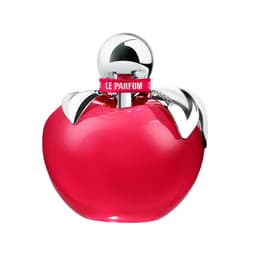
Nina Le Parfum: the icon takes a bite of the night. Eighteen years after the famous pink apple of 2006, Nina Ricci presents Nina Le Parfum (2024). Perfumer Olivia Giacobetti reorchestrates the gourmand tale: the emblematic candy apple turns more carmine, coated in a salted butter caramel heightened by a burst of lemon, before giving way to a velvety jasmine and a long-lasting woody vanilla. More sensual than the original, more couture than the whimsical editions, this intense juice dresses the woman in a scarlet red gown and follows her to the end of the night.
The accord announced by the house
Nina Ricci describes Nina Le Parfum as a fruity floral woody composition, conceived to evoke a forbidden fruit. The brand highlights a trio of apples enhanced by an upcycled Italian lemon, without detailing a breakdown into top, heart and base notes.
Wikiparfum’s reading
Wikiparfum offers a more detailed pyramid: in the top notes, a trio of apples and an upcycled Italian lemon, matching the fruits announced by the house; in the heart notes, orange blossom, gardenia and tuberose, absent from Nina Ricci's official account.
What the label declares
The label lists limonene, linalool, benzyl alcohol, geraniol, farnesol, benzyl benzoate, citral, coumarin, eugenol, citronellol, hydroxycitronellal and cinnamal. Citral and limonene align with the citrus announced in the top notes, while linalool and eugenol may accompany the white flowers cited by Wikiparfum.
What is left out
Neither the house nor Wikiparfum describes a distinct base for Nina Le Parfum: the vanilla, cedar and musk sometimes attributed to this base appear in neither source. The orange blossom, gardenia and tuberose in the heart come from Wikiparfum alone.