
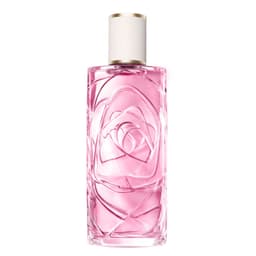
Ô Oui joins Lancôme’s Les Ô collection in 2026, a year after its launch. This floral fruity Eau de Toilette pairs a lychee accord and bergamot with the centifolia rose the house grows in Grasse, over a base of ambrette and musks. Lancôme credits the composition to Quentin Bisch and Louise Turner, perfumers at Givaudan. The name echoes a perfume from 1999, with nothing else carried over.
Lancôme files Ô Oui among the fruity florals and publishes three tiers: a lychee accord and bergamot oil in the top, the centifolia rose from the Domaine de la Rose in the heart, ambrette and musks in the base. This breakdown from the house is reproduced here as is.
Top
The lychee accord opens the perfume, wrapped, the house says, in a fluid, fresh and colorful veil. Italian bergamot reveals its most natural, juicy and sparkling facets. The fruit is not extracted: Lancôme speaks of an accord, that is, a scent rebuilt by the perfumer.
Heart
The centifolia rose, or May rose, comes from Lancôme’s Domaine de la Rose in Grasse. The house describes it as transparent, with warm, slightly spicy notes; it unfolds its floral facets alongside the lychee and extends the impression of airy freshness.
Base
Ambrette, the musky seed of a plant related to hibiscus, and musks form the base. Lancôme speaks of a secret touch of ambrette and promises a petal-like sensation, fresh and addictive, which completes the composition without weighing it down.
What stays out
Monoi and the name of Dominique Ropion, sometimes attributed to Ô Oui, belong to Ô Zenith, its 2025 sibling. Raspberry and vanilla belong to the mist of the same name. Finally, the label declares a geranium oil and a lemon oil that the published notes do not name.
What the label declares
The published list counts twenty-nine ingredients. After alcohol, fragrance and water come a synthetic molecule, tetramethyl acetyloctahydronaphthalenes, and a UV filter, butyl methoxydibenzoylmethane. Three colorants tint the juice pink: CI 14700, CI 19140 and CI 60730.
It names four natural materials: geranium flower oil, rose oil or extract, and bergamot and lemon oils. It also declares constituents of these materials, including linalool, geraniol, citronellol, limonene, citral, coumarin and farnesol.