
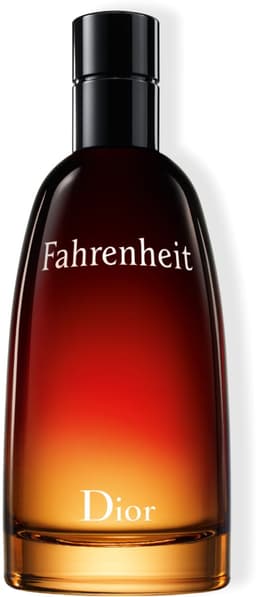
Launched by Dior in 1988, Fahrenheit shook up men’s perfumery with an unprecedented accord of violet leaf, wood and leather, opened by the freshness of Sicilian mandarin. Signed by Jean-Louis Sieuzac, it was an immediate success and divided as much as it seduced. Its bottle with a fiery gradient was born, according to the house, from a flaw in the cooling of the glass.
Dior today sums up Fahrenheit in three movements: the freshness of Sicilian mandarin, an unprecedented violet accord, and the pairing of wood and leather. For the Fragrance Foundation France, the accord of wood and violet leaves with green accents ranks among the historic accords of perfumery.
Top
Sicilian mandarin opens the fragrance. The house notes that Sicily produces the finest quality and that its citrus essence gives a fruity, fresh note, like a longing to travel.
Heart
Violet leaves dominate the heart. Dior credits them with a powerful, very particular scent, green, vegetal and barely floral. Kevin, at Now Smell This, smells in it a nutmeg and violet accord that he likens to an old wooden pole coated with tar.
Base
Leather dominates the base. The house links it to the Russian leather of hussars’ boots, tanned with birch bark, and says it recreated its burnt, smoky notes with birch, styrax and cade.
The 1988 version
The original composition, which Persolaise considers quite different from today’s eau de toilette, combined in his view a very green violet leaf, woods and a leather as if soaked in gasoline. Kevin also noted honeysuckle, hawthorn, bergamot, cedar, sandalwood and patchouli.
What stays out
Lavender, lemon, vetiver and the long lists of flowers attributed to Fahrenheit, carnation, jasmine or lily of the valley, do not appear in the house’s current presentation.
What the label declares
The ingredient list names alcohol, water and fragrance first, along with a synthetic ambery wood, Iso E Super, and bergamot essential oil. It also names patchouli oil and clove oil.
It lists methyl octynoate, a molecule that smells of violet leaf, a synthetic musk, galaxolide, three UV filters and several allergens, including coumarin, eugenol, isoeugenol and citral.
Similar perfumes
Similar notes and family, from other houses.
- Aventus CologneCreed
- Russkaya KozhaBerdoues
- WantedAzzaro
- Bois LaqueMarie Jeanne
- Pierre NoireMarie Jeanne
- Oud MinéraleTom Ford
- Club de Nuit Intense ManArmaf
- AventusCreed
From the same line
More perfumes from Christian Dior
Also composed by Jean-Louis Sieuzac
- Bel AmiHermès
- OpiumYves Saint Laurent
- Opium Eau de ToiletteYves Saint Laurent
- Play for Her IntenseGivenchy