
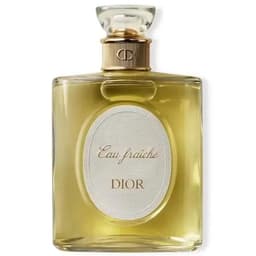
Eau Fraîche appeared in 1955, composed by Edmond Roudnitska for Dior. The house presents it as the forerunner of fresh fragrances: a citrus chypre built on Sicilian mandarin, bitter petitgrain and Indonesian patchouli. Francis Kurkdjian restores its original formula on 1 October 2026, alongside the twelve other Dioriginals.
The house declares three materials for the version sold today.
Mandarin, petitgrain, patchouli
Sicilian mandarin opens. The whole Mediterranean basin grows the mandarin tree, the house recalls, but Sicily yields the best quality; yellow, green and red mark stages of ripeness in the fruit.
Bitter petitgrain holds the centre. Grown in Paraguay, it comes from distilling the leaves and twigs of the bitter orange tree, and serves as a base for colognes; the house grants it a green bitterness and floral accents.
Indonesian patchouli stays at the base. Its essence is obtained by steam distilling the dried leaves, and the house lends it a sensuality that holds for women as much as for men.
What stays outside
The label declares an oakmoss extract that the three materials published by the house do not carry: the chypre side of the fragrance cannot be read in what it announces.
The basil and tarragon accord, which Kurkdjian gives as the signature of Eau Fraîche, belongs to the original formula and to its restoration. It does not enter the version on sale until 1 October 2026.
Stéphan for his part hears several mandarins, yellow, green and orange, accompanied by bergamot and carried by a chypre accord perceptible from the opening. These materials stay outside what the house declares.