
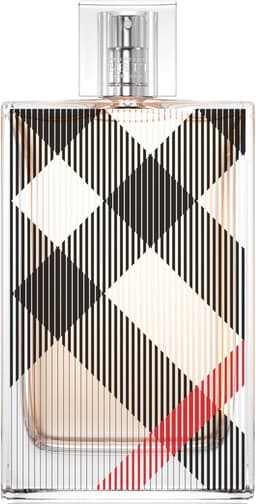
Frosted pear, green almond and Italian lime open Brit pour Femme on a short, crisp freshness. The powdery heart rests on two materials, sugared almond and white peony, which Jeanne Doré read instead as a heliotrope. The base brings together vanilla, tonka bean, amber and mahogany. Nathalie Gracia-Cetto composed this eau de parfum for Burberry in 2003; it won the FiFi the following year.
Brit pour Femme, released in 2003, rests on a short list. Pear, almond and limetta at the top; sugared almond and white peony at the heart; vanilla, tonka bean, heliotrope, amber and mahogany at the base.
This list circulates everywhere without varying by a single rank, which does not make it so many distinct attestations. An independent reading does exist, however, published by a critic, and it does not say quite the same thing.
One letter's difference between a fruit and a spice
French descriptions of the opening waver between two materials. Some announce a frosted pear, others a frosted pepper, and some marketing texts carry both forms a few lines apart.
No original inventory mentions pepper. The English versions write frosted pear or icy pear, the icy pear the brand has promoted since the perfume's release in 2003.
The typo traveled far: it hinges on a single letter, and the material it invents remains plausible in a fresh opening. That is what made it so hard to spot.
Sugared almond for the brand, heliotrope for the critic
The brand describes a heart of sugared almond and white peony. In her March 2006 review, Jeanne Doré does not name the sugared almond: she perceives a powdery heliotrope, which she places in the base with the almond and the tonka bean.
The two readings may point to the same thing. Heliotropin carries that powdery, sugary almond scent that confectionery calls sugared almond, and a material can be named by its effect as much as by its substance.
The discrepancy also concerns the tier. The brand places the powdery note in the heart, the critic in the base, and nothing in the available documents allows a decision between these two placements.
What repetition does not prove
The note list recurs page after page in an identical order. This regularity points to a single copied source, not to an agreement among independent observers.
A sugar note appears among the heart notes in this chain, and nowhere else. Absent a second witness that does not descend from that page, it remains outside the retained list, like any material with only one source.
Almond, for its part, holds on both sides: the inventories give it as green at the top and candied at the heart, and Jeanne Doré finds it again in the base, rounded and powdery, twenty years after the release.
A classification that changes with the hour
Databases and marketing copy place Brit among fruity florals. Auparfum classifies it as amber, and Jeanne Doré writes gourmand oriental, very vanilla-forward, in her 2006 review.
Both readings describe the 2003 juice. The fruity, short opening supports the first, the warm, persistent base of vanilla, tonka, amber and mahogany supports the second.
No arbitration imposes itself from outside. A fruity floral whose vanilla lasts several hours can be described by either label, depending on when it is smelled.
Two licensees, two manufacturing chains
The 2004 award was given to Cosmopolitan Cosmetics. The ingredient list on the current bottle bears the name Coty: two successive licensees, therefore two different manufacturing chains.
The allergens declared today include linalool, limonene, coumarin, citral, cinnamal, geraniol and hexyl cinnamal. Coumarin here signals the tonka bean of the base, citral and limonene the citrus of the top.
A change of licensee does not automatically imply a reformulation, and no public document establishes one for Brit. Both facts are established; the link between them is not demonstrated.