
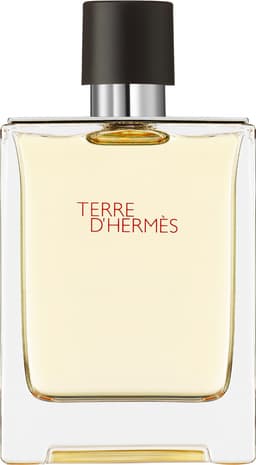
Hermès let eight years pass after Rocabar before entrusting a masculine to Jean-Claude Ellena, its exclusive perfumer. Released in March 2006, Terre d’Hermès rests on three raw materials that the house itself claims: grapefruit, cedar, flint. Its creator was seeking a vertical woody smell, the image of a man standing on the earth. Awarded as early as 2007, the juice has since been reworked, and that reworking still feeds a disagreement that the house has never settled.
Terre d’Hermès was judged by the specialized press as soon as it came out, and it still is every year by those who have worn it for twenty years. The two judgments do not say the same thing, and the gap between them stems from a reworking of the formula.
Olfastory’s review
What critics wrote about it in 2007
Jeanne Doré published her review in June 2007 in Auparfum, under a title that states her verdict: Terre de bois. She classifies the juice as citrus woody and immediately ties it to the function the house had assigned it.
Her judgment is measured, and that is what makes it useful. She describes a simple, harmonious structure, timid and lacking in power on first contact, whose discretion and consistency make precisely for its elegance and understatement.
This reading involves a bias worth pointing out: it treats as a quality what others will consider a weakness. A juice that does not assert itself can be seen as refined or as flat, depending on what one expects from a masculine.
Three states of the juice, datable by the box
A reformulation guide proposes dating bottles by their packaging. A large galloping horse on the box would signal batches predating 2016, a reduced horse intertwined with the logo those from after, the wording printed on the front those from after 2022.
According to this same guide, the first two states remain close, with a more defined vetiver and mineral accord in the older ones. The break would occur at the third, tied to the restriction on Iso E Super.
An independent comparison set side by side nine batches produced between 2009 and 2014. Its author warns of a preliminary difficulty that most discussions ignore: counterfeiting has reached a degree that makes authentication difficult without the bottle in hand.
A molecule at the center of the trial
Long-time wearers all describe the same thing in similar terms: a juice that has become thinner, whose sillage has shrunk. On the French review site, one reader writes that the fragrances of the early days are no longer present.
The grievances go further for some. One judges the vetiver coarse and sees in the commercial success the effect of a molecule that deliberately damages the rest. Another prefers the Eau Très Fraîche and finds the eau de toilette rough.
These complaints are not unanimous, and it would be dishonest to present them as the general verdict. The same pages carry readers who consider the juice easy to wear and endowed with a frank character.
What the numbers do not allow one to say
Two sets of figures circulate about the restriction. The first gives a formula loaded at fifty-five percent of the molecule, brought down to twenty-one point four. The second corrects both the year and the ceiling, places the measure in 2020 and sets it at twenty percent.
Settling between the two versions is not possible at present. Neither traces back to the regulatory text itself, and both rely on pages that cite one another rather than a primary reference.
What remains established fits in few words. The formula has changed, the house has not publicly commented on it, and those who have worn the juice since its origin agree on the direction of the change even when they differ on its extent.