
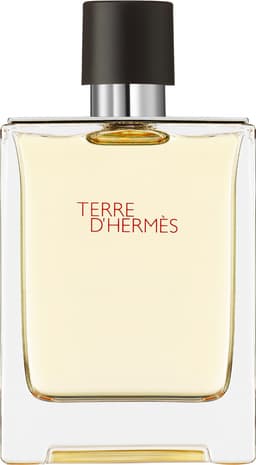
Hermès let eight years pass after Rocabar before entrusting a masculine to Jean-Claude Ellena, its exclusive perfumer. Released in March 2006, Terre d’Hermès rests on three raw materials that the house itself claims: grapefruit, cedar, flint. Its creator was seeking a vertical woody smell, the image of a man standing on the earth. Awarded as early as 2007, the juice has since been reworked, and that reworking still feeds a disagreement that the house has never settled.
Flint, claimed by both the house and its creator
Hermès does not publish a long list. The house cites three main raw materials for the eau de toilette: grapefruit, cedar, flint. This choice of three names stands in for a description, and places a mineral material on the same level as two plant materials.
Flint is not an extractible raw material. What perfumery calls by this name synthetically recreates an impression of rubbed stone, dry and cold, close to what everyday language calls the smell of gunflint.
The interview given by Ellena confirms this intention and gives its technical reason. Seeking a vertical wood, he set aside sandalwood, which he considered too languorous and too horizontal, kept cedar for its nervous quality, and paired it with a flint smell.
The freshness comes from a separate decision, stated in this interview: a masculine required, in his view, a sharp opening, and grapefruit provided that idea. The three materials the house publishes are therefore the same three the perfumer names.
A citrus top, and a disputed bergamot
The 2007 review describes an opening broader than these three names. Jeanne Doré notes bergamot there, a slightly bitter grapefruit note, and a green, fruity accord she likens to rhubarb.
Orange appears in the notes the brand otherwise circulates, and a chromatographic analysis of the juice finds it alongside grapefruit. The brand and the laboratory agree on this point, which is enough to retain it.
Geranium appears in the notes the brand circulates, under the botanical name pelargonium. The 2007 review does not mention it, and the analysis of the juice merely notes unnamed florals. It is kept on the strength of the manufacturer's declaration.
Bergamot was contested by a reader of the same review, on the grounds that so discreet a material cannot stand out in a juice so heavily loaded with woody molecule. The objection concerns perception, not the formula.
This disagreement deserves to be kept as is. A material can appear in a formula and remain undetectable to the nose, and both claims can be true at once without either canceling out the other.
The woody base, and the molecule that carries it
The body of the juice is woody, and the review describes it through three materials: cedar, vetiver, patchouli, with smoky, peppery and leathery effects. Black pepper and geranium round out the middle, benzoin anchors the base.
Iso E Super deserves to be named, something commercial sheets avoid. This woody, velvety, transparent molecule serves as the backbone of many masculines of the two-thousands. An analysis of the juice gives it in a considerable proportion.
Its presence explains the mineral sensation as much as flint itself does. It extends the woods without weighing them down and produces that dry, luminous quality that many attribute to stone, when it largely comes from a synthetic.
The analysis counts about thirty constituents, which places the formula far from the dense assemblages typical of its era. The figure remains indicative: a chromatography identifies what it is able to recognize, and nothing obliges an independent laboratory to retrieve the complete formula.
The product's official list of allergens notably mentions limonene, hydroxycitronellal, citronellol, hexyl cinnamal and linalool. These regulatory mentions do not describe the formula, but they confirm the presence of floral and citrus materials not listed by the brand.
Three materials that nothing supports
Widely copied inventories credit Terre d’Hermès with lemon, shiso and oakmoss. Neither the house, nor the perfumer, nor the 2007 review, nor the analysis of the juice mentions them.
Shiso is nonetheless a real material, a Japanese herb with green and minty facets, used in perfumery. Its attribution to this juice seems to stem from a confusion copied from one source to the next, without any identifiable author having originally made the claim.
Part of the confusion comes from the line itself. The 2009 parfum version carries a distinct formula, denser and woodier, and many inventories attribute to the eau de toilette materials noted on that version, or the reverse.
These three names therefore remain outside, and nothing comes to replace them. A false list costs the reader more than a short one, and nothing requires counting as many names as catalogs line up.