
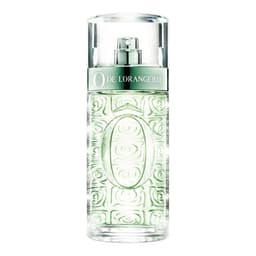
Ô de l’Orangerie, delicately sensual The beauty of women has always been the purpose of the Lancôme house. From the very beginning, Lancôme has devoted an endless cult to women of all generations.
How does one bring a great classic of perfumery back to life by modernizing it without being unfaithful to it? This was the challenge faced by four perfumers who created, forty years after Ô, two flankers to the legendary fresh eau for Lancôme: Ô d’Azur and Ô de l’Orangerie. While Ô d’Azur sings the pleasures of a fruity floral, Ô de l’Orangerie chose to let orange blossom shine within the fresh cascade of the original juice.
Ô de l’Orangerie, or the rebirth of a perfumed myth in precious orange blossoms
Ô de Lancôme was born in 1969. At the time, eaux de cologne were used only by men, and feminine perfumery leaned far more toward opulent floral perfumes than fresh eaux. And yet, when the lovely and so fresh Ô was released, a wave of aquatic freshness swept across the shelves of every perfumery. From then on, Ô never left, becoming over the years one of the undisputed masters of the fresh eau, alongside the famous Eau de Rochas.
To celebrate its fortieth anniversary, Lancôme invited four talented perfumers to recreate original, modern compositions around Ô. Ô d’Azur was composed by Domitille Bertier and Sophie Labbé. Ô de l’Orangerie was composed by Dominique Ropion and Anne Flipo in 2011.
Whether Ô d’Azur or Ô de l’Orangerie, the perfumers chose to change only the floral heart of the iconic Ô, which at the time was composed of honeysuckle, jasmine and a green aromatic accord. For Ô d’Azur, the heart takes on fruity, sugary notes; for Ô de l’Orangerie, it is orange blossom and an ozonic note that occupy the floral heart with their sparkling light.
Knowing the talent of the two perfumers and Dominique Ropion’s great love of orange blossom, it was safe to bet that Ô de l’Orangerie would live up to its brilliant elder.
Orange blossom: a raw material of tremendous richness, revealing facets ranging from the purest innocence to the most venomous charms. Quite a feat! Dominique Ropion.
Between hedione and an ozonic note, Ô de l’Orangerie modernizes the cult Ô de Lancôme
To shake up the codes of perfumery, Lancôme had managed to showcase, in a feminine fragrance, the famous hedione molecule, discovered in the 1960s. Hedione was used to create for Ô a fresh cascading effect. This cascade of Ô, or of Lancôme’s water, was due not only to the revolutionary molecule known until then only in Eau Sauvage, but also to citrus notes of lemon and mandarin with an obvious dynamism. Hedione thus gave the impression of a sparkling aquatic freshness while carrying floral facets recalling, above all, the delicate scent of jasmine.
To compose this Ô de l’Orangerie, Dominique Ropion and Anne Flipo kept Ô’s tangy top notes but paired them with an ozonic note that this time highlights the sun-kissed power of orange blossom far more than the cascade effect. By replacing hedione with the ozonic note, the two perfumers thus heightened the airy top notes while giving the heart a very modern metallic power.
We had in mind the idea of a fresh, radiant femininity. And we dreamed of a refined fresh eau that would celebrate this mythical flower of perfumery, letting it reveal itself with modesty and majesty. Dominique Ropion on Ô de l’Orangerie for Lancôme.