
Berdoues
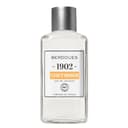
1902 Fleur d'Oranger Eau de Cologne
Three materials drawn from the same tree — petitgrain from the leaves, neroli from the distilled flower, absolute from the orange blossom — for a cologne that the Cugnaux house openly calls regressive, softened with a white musk. A white floral freshness, brief and reassuring, without pretension or detour, at a price that invites one to use it freely.
Where to buy
The bitter orange tree, or bigaradier, is the most generous tree in perfumery: it alone supplies four distinct materials. The zest of its fruit gives bitter orange essence, its leaves and twigs give petitgrain, its steam-distilled flower gives neroli, and that same flower treated with solvent gives orange blossom absolute. Four smells, four prices, four characters, all from the same orchard. This Eau de Cologne calls on three of them, which amounts to turning the tree on itself.
The exercise has a logic to it. Neroli is bright, almost metallic in its first seconds, with that cold edge that keeps white flowers from becoming cloying. Petitgrain contributes the green, the bitter, the smell of a broken stem. The absolute, for its part, is the richest of the three: honeyed, slightly animalic, carrying what perfumers call indole, the molecule that smells of overripe flowers and gives jasmine and tuberose their thickness. Put together, the series runs from driest to roundest.
Berdoues uses the right word to describe the effect: regressive. In France orange blossom belongs to domestic memory before it belongs to perfumery — the orange blossom water of brioche and crêpes, the kind grandmothers poured into warm milk. The juice plays on that familiarity without caricaturing it: it remains a cologne, not a dessert, and the bitterness of the petitgrain is there to remind that one is on the side of the plant.
The house that makes it is a family-run business from the Toulouse region, based in Cugnaux, now in its fourth generation. Its cologne collection includes about fifteen references, several of which turn around the same register — a Musc & Néroli, a Naturelle with orange, an Orange Fizz. This one stands apart by placing the flower at the center rather than as an accompaniment.
Only two sizes: the refillable 125 ml spray bottle and the 245 ml splash, without the large 480 ml bottle that the range reserves for its best-selling references. On the formula side, the house claims 98% naturalness, an alcohol of agricultural origin, and no ingredient of animal origin. As for the customers who fault it for fading too soon, they are mostly describing the category: at this concentration, one reapplies during the day — that is how it was designed to be used.
There remains the question of price, which is not incidental in this territory. Orange blossom is a material that niche perfumery has worked extensively, often at niche prices. Here, the 245 milliliter bottle sells for around twenty euros, the 125 ml spray bottle a little less still when bought directly from the brand. This ratio changes the way one wears the fragrance: one does not dose a cologne at this price the way one rations an extrait, one applies it generously, reapplies it, and that is precisely the use it was designed for.
Olfactory pyramid
- Top notesThe first minutes
- Heart notesThe heart of the perfume
- Base notesWhat lingers
Share your impressions
Create an account to keep your votes and find your notebook.