
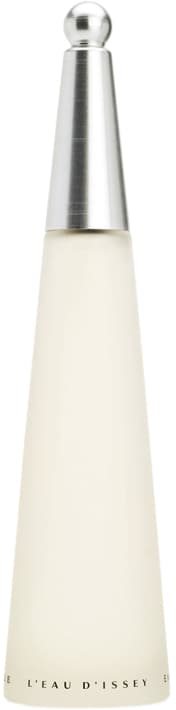
A floral aquatic released in 1992, L’Eau d’Issey is the first perfume by Issey Miyake and the first signature of Beauté Prestige International. Jacques Cavallier built the lotus and rose accord that the house announces in the top notes, over a heart of lily and peony and a woody, musky base. Calone carries the smell of water throughout. The name plays on the word odyssey, and the bottle, a cone topped with a sphere, comes from a full moon seen above the Eiffel Tower.
Few perfumes have been worn as much, copied as much, or debated as much for the wrong reasons. What the house says about it and what critics smell in it do not coincide. Here are the points where opinions hold together, and those where they flatly contradict each other.
Olfastory’s review
Mass success complicates the reading. A perfume sold everywhere for thirty years ends up being judged as much on the memory it leaves as on its smell, and the two are hard to untangle once the bottle is capped again.
Where opinions agree
The clarity of the opening is not in dispute. Lotus, rose and the marine note draw a clean entrance, without heavy sugar or powder, and Anglo-American critics still recognize in it a cleanness that has not aged.
The bottle achieves the unanimity the juice does not. Glass cone, sphere on top: thirty years on, it still passes for modern on a dressing table, and reviewers cite it before speaking of the scent.
Where they divide
French critics dispute the word transparency. They read a heady, honeyed floral with a wide sillage, far removed from the minimalism the brand claims. The disagreement does not concern a detail: it concerns the very nature of the juice.
The opposite criticism also exists. Some readers find the composition linear, held together by a white accord of lily and fresh flowers that overwhelms everything else, and prefer a more defined eau.
The question of lineage
Detractors see it as a rehash of Escape, released by Calvin Klein a year earlier. Specialized critics reject this reading and credit it with having opened the floral aquatic genre rather than having imitated it.
The debate cannot be settled by dates alone. Both juices use the same marine material, and the precedence of one launch says nothing about which formula was written first in the laboratory.
What cannot be said
Nothing dates a reformulation of the feminine version. The batch guides in circulation all concern the masculine version, released in 1994, and remain silent on this one. The question stays open, for lack of a serious record.
Sales figures are not verifiable either. The American success of the 1990s comes up everywhere without ever being quantified, and it is better to state it this way than to copy a number with no traceable source.