
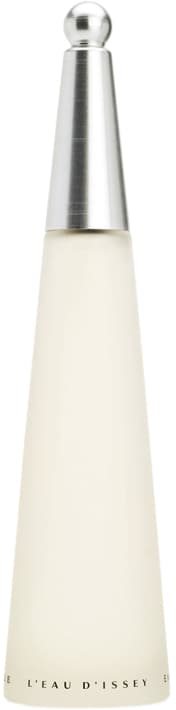
A floral aquatic released in 1992, L’Eau d’Issey is the first perfume by Issey Miyake and the first signature of Beauté Prestige International. Jacques Cavallier built the lotus and rose accord that the house announces in the top notes, over a heart of lily and peony and a woody, musky base. Calone carries the smell of water throughout. The name plays on the word odyssey, and the bottle, a cone topped with a sphere, comes from a full moon seen above the Eiffel Tower.
Classified as floral marine by the Société Française des Parfumeurs, L’Eau d’Issey rests on a lotus and rose accord opened by a marine note, a heart of lily and peony, and a base of wood and musks that the brand alone details.
Calone, the key material
The molecule is called methylbenzodioxepinone, known in the trade as Calone 1951. Its smell recalls oyster and sea spray, with a fruity note of watermelon. Discovered in the 1960s, it was waiting for a perfume to bring it out of the laboratory.
Cavallier did not invent it, and L’Eau d’Issey was not the first juice to contain it. The credit lies elsewhere: a success wide enough to make the material worth copying, and an entire feminine shelf that shifted behind it.
Lotus and rose, in the top notes
The house announces a floral duo, lotus and rose, which it describes as powdery and fresh. The Fragrance Foundation names both flowers. Lotus, for its part, cannot be distilled: its smell is a reconstruction that perfumery builds entirely from scratch.
The marine note takes third place and carries the idea of the brief. Rose and lotus give it a floral outline that calone alone would not have had, and the opening stays clear without turning fruity.
A brief heart, a sparsely detailed base
The heart is limited to two white flowers, lily and peony. The house speaks of a fresh, sun-kissed bouquet; lily carries a crisp whiteness, peony a softer, less sharp roundness, without sweetness.
The base returns to white musks, sandalwood, cedar and amber. These woods come from the brand’s description; elsewhere, one reads only of a woody, musky sillage, which agrees without detailing anything further.
What the nose finds
French critics do not read the transparency claimed. They describe a heady, powdery, honeyed floral, in which honeysuckle and mock orange weigh more than water, lifted by a sweet touch of melon, and a wide sillage.
Two readings stand in direct opposition: a discourse of purity and restraint on one side, a floral, honeyed opulence on the other. Neither prevails, and the divergence may owe less to the juice itself than to what is expected of it.
Twelve other flowers circulate on online lists — lily of the valley, carnation, osmanthus, tuberose, freesia, cyclamen — always in the same order, from page to page. A single source carries them, and they do not appear here.