
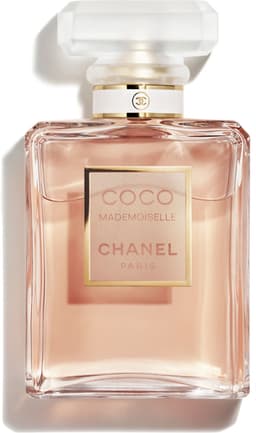
Coco Mademoiselle is the eau de parfum Jacques Polge composed for Chanel in 2001, for a younger clientele than that of Coco. The house describes it as a feminine amber of surprising freshness: orange opens onto a sheer accord of jasmine and rose, and patchouli and vetiver draw an amber-woody base.
A guarded reception from reviewers: Angela of Now Smell This likes smelling it on others but no longer wears it, put off by its shrill floral and its musks; Suzanna of Bois de Jasmin finds a green, sweet patchouli in it, in the lineage of Angel.
What critics say
A shrill floral for Now Smell This
On December 14, 2009, Angela, a reviewer for Now Smell This, credited Jacques Polge for not simplifying the formula. She nonetheless regretted a shrill floral burst that recalls no identifiable combination of flowers, and caught a hint of peach in it.
She compared the effect to driving a car with a slack fan belt: bearable for a few seconds, irritating beyond that. The musks in the base bothered her even more, and she concluded that she likes catching the perfume on others without wanting to wear it.
A patchouli in the lineage of Angel
On August 10, 2012, Suzanna, who writes for Bois de Jasmin, presented Coco Mademoiselle as the best-selling women’s fragrance in the United States. She judged that it has almost nothing in common with Coco, apart from a positioning aimed at young women.
She smells a greenish, herbal patchouli in it, coated with vanilla and fruit syrups, and places the perfume among the descendants of Angel, Thierry Mugler’s gourmand patchouli. This somewhat sticky patchouli, which she also finds in Chance, long kept her from wearing it.
She prefers the line’s dry oil, in which vanilla and white musks round out the patchouli: a softer version, whose notes all seem to appear at once, and which she finds eminently pleasurable.
From the same line
- Coco
- Coco Mademoiselle Eau de Toilette
- Coco Noir
- Coco Mademoiselle Intense
- Coco Mademoiselle L'Eau Privée
- Coco Mademoiselle Crush Absolu
- Coco Eau de Toilette
- Coco Noir Extrait
The whole line on the blog: Chanel’s Coco: the whole line, from 1984 to 2026
More perfumes from Chanel
Also composed by Jacques Polge
- La Vie est Belle par Lady PinkLancôme
- Rive GaucheYves Saint Laurent
- Diva Eau de ParfumEmanuel Ungaro
- We Are All AlienThierry Mugler
Similar perfumes
Similar notes and family, from other houses.
- HypnôseLancôme
- My Burberry BlackBurberry
- Black MeisterstuckMontblanc
- Aqua Kenzo pour FemmeKenzo
- Poison Girl UnexpectedChristian Dior
- Black Orchid Eau de ParfumTom Ford
- SatineLalique
- Quatre en RoseBoucheron