
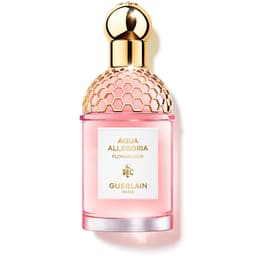
Launched in early 2024 in the Aqua Allegoria collection, Florabloom is signed by Delphine Jelk. Inspired by desert superblooms, this bouquet gathers Grasse rose and iris and violet accords around a tuberose partly obtained by enfleurage, over a top of bergamot, lime and mango.
What the house declares
Guerlain speaks of a rainbow-colored bouquet with a strikingly realistic tuberose at its center. Grasse roses and powdery iris and violet accords surround it, over a mossy base that gives the whole a sunny, creamy glow.
The tuberose combines three materials: a Grasse pomade obtained by enfleurage in a vegetable butter, an absolute and a CO2 extraction of Indian tuberose. The house pairs it with a mango accord, and sources its Grasse flowers from Le Mas des Sources, an organic grower.
CosmeticOBS notes that the CO2 extraction was carried out for the first time in India, near the fields, at low temperature, and sees it as an alternative to petrochemical solvents. Enfleurage, for its part, replaces the animal fat of old with a vegetable butter, in a process that has remained entirely manual.
Three tiers
The house breaks its fragrance down into three stages: bergamot, lime and mango accord in the top; tuberose, rose, iris and violet in the heart; musk, sandalwood and coconut extract in the base, according to the texts it supplies to perfume retailers.
What the label declares
The list Guerlain publishes declares, after alcohol, fragrance and water, limonene, rose flower oil or extract, linalool, bergamot oil and bitter orange peel oil, one UV filter, butyl methoxydibenzoylmethane, and alpha-isomethyl ionone.
It also shows methyl anthranilate, benzaldehyde, sandalwood (Santalum album) oil and santalol, hexadecanolactone, coumarin, isoeugenol, vanillin, citral, geraniol, farnesol and citronellol, along with three colorants, a violet, a red and a yellow.
Similar perfumes
Similar notes and family, from other houses.
- La Nuit Trésor NudeLancôme
- Olympea ElixirPaco Rabanne
- Flowerbomb Tiger LilyViktor & Rolf
- Eau de Lacoste L.12.12 NaturalLacoste
- Paris Très Chic Coco LumièreAvon
- Joy Eau de ToiletteJean Patou
- Bloom Eau de ParfumGucci
- MichelleBalenciaga