
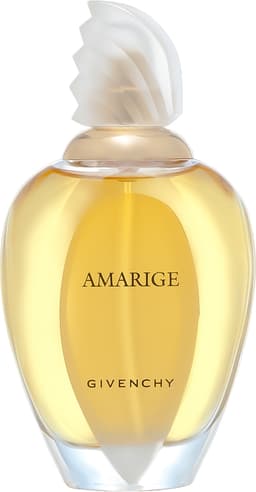
Amarige is the floral Dominique Ropion created for Givenchy in 1991, and its name is an anagram of “mariage,” the French word for marriage. Today the house describes it through three materials, gardenia, mimosa and precious woods, and links it to the shores of the Mediterranean. Its bottle, designed by Pierre Dinand, draws on the ruffled sleeves of a blouse created by Hubert de Givenchy.
Givenchy today presents Amarige in three stages: a gardenia at the top, a mimosa in the heart and precious woods in the base. The house speaks of a generous floral bouquet, radiant with cheer and tenderness, with soft, sweet notes.
Critics smell far more than these three materials. Luca Turin and Tania Sanchez describe a green, soapy, tobacco-tinged tuberose accord; Portia, on Perfume Posse, notes the creamy richness of ylang paired with mimosa; Anne-Marie finds a joyful peach.
What stays out
The peach, plum, orange blossom, neroli, jasmine, cassie, amber woods, vanilla, white musks and sandalwood long associated with Amarige do not appear in the house’s current presentation, and neither does tuberose. They remain here in prose.
What the label declares
The house’s ingredient list begins with alcohol, fragrance and water. It names twelve regulated allergens, among them benzyl salicylate, linalool, farnesol and isoeugenol, as well as three UV filters, the antioxidant BHT and two colorants, yellow and red.
Similar perfumes
Similar notes and family, from other houses.
- Flower Ikebana Mimosa by KenzoKenzo
- Jardins de BagatelleGuerlain
- DaisyMarc Jacobs
- Dylan Blue pour FemmeVersace
- Fleur de Rocaille Eau de ParfumCaron
- Flower by Kenzo IkebanaKenzo
- Kelly CalècheHermès
- Cristal d'EauRepetto
More perfumes from Givenchy
Also composed by Dominique Ropion
- La Vie est Belle FloraleLancôme
- Miutine IntenseMiu Miu
- Lady Million MonopolyPaco Rabanne
- Lady Million Collector Noël 2017Paco Rabanne