
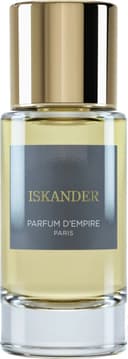
Iskander
Because perfume possesses a universal and timeless language, the house Parfum d'Empire chose to plunge us into the outer reaches where East meets West. Iskander is a radiant juice woven with finesse.
- Brand
- Parfum d'Empire
- Launch year
- 2006
- Perfumer
- Gender
- Unisex
- Olfactory family
- Citrus
- Concentration
- Eau de Parfum
Where to buy
It showcases the brightness of citron while accentuating it with aromatic facets of tarragon and coriander, letting it all rest on a sensual base of amber and moss. Iskander is described by its creator, the celebrated Marc-Antoine Corticchiato, as a fragrance that is luminous and invigorating. It speaks to all men eager for power and self-transcendence. It has neither spatial nor temporal boundaries, but has the sole ambition of conveying, with restraint and confidence, a universal message.
Iskander, a rather enigmatic name
Iskander is a strange and uncommon name for a perfume. It leaves the consumer puzzled, sparking within them a surge of curiosity that invites both engagement and discovery. In reality, it draws its origin from Arabic culture. This choice can be explained by the fact that Marc-Antoine Corticchiato, director of the house Parfum d'Empire, grew up in Morocco. Thus, although he is of Corsican origin, this artist is also deeply attached to Eastern culture. Iskander is a first name that gave rise to the well-known name Alexander. It means protection and virility. As one will have understood, Iskander is a perfume conceived in the image of Alexander the Great. It is a fragrance synonymous with conquest and fits perfectly, in this sense, into the great lineage of Parfum d'Empire fragrances. It is intended, as it happens, for great men, pushing them to always go a little further and to accomplish true feats.
The sun-drenched power of an essence signed Parfum d'Empire
Iskander bases its composition essentially on the vitality of citrus. Evocative both of the Mediterranean, where they are cultivated today, and of Asia, where they originate, these citrus fruits are meant to be universal. Iskander contains, moreover, citron, Chinese mandarin and Southeast Asian grapefruit. The result is a rendering that is at once sparkling, tangy, fruity, green and slightly bitter. Nevertheless, Iskander is also a perfume of paradoxes. A darker, woodier base comes to contrast with this apparent clarity. It is steeped in oakmoss and amber, then wrapped in the sensuality of musk. Iskander then gradually becomes a chypre fragrance. It depicts the image of springtime China combined with that of Arabian shores as well as that of Macedonian forests. One might almost say that Iskander becomes akin to a perfume stolen from the gods by men in search of immortality.
Olfactory pyramid
- Top notesThe first minutes
- Heart notesThe heart of the perfume
- Base notesWhat lingers
Share your impressions
Create an account to keep your votes and find your notebook.