
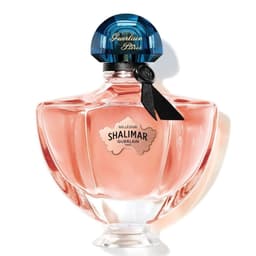
The fifth vintage of the Millésime collection, Shalimar Millésime Rose brings forward the only raw material of the Guerlinade that had not yet had its year. Delphine Jelk layers three states of the flower, obtained through three different processes: Centifolia absolute from Grasse, Damascena essence, and rosewater. The incense, discreet in the 1925 perfume, is brought back up. Limited edition of fifty milliliters, released in spring 2026.
A Millésime must remain recognizable without being identical. Delphine Jelk resolves the constraint by leaving both the citrus opening and the amber base untouched, and concentrating all the work on the floral tier.
The top combines rosewater, almond and bergamot. The hydrolate gives a watery, almost transparent entry, far from the weight expected here. Bergamot stretches it and recalls the citrus opening that has always been that of the 1925 perfume. Almond divides opinion: the regulatory list carries benzaldehyde, its most direct marker, but several noses find it discreet enough to miss.
The heart layers the two noble roses. Damascena brings the fruity quality and extends the almond from the top, of which it is a natural facet rather than an addition. Centifolia arrives behind it with honeyed accents and gives the thickness that a fresh rose alone would lack. May rose oil counts more than three hundred constituents, some of which remain unidentified: this is what makes it impossible to reconstruct through synthesis, and what justifies its price.
The base returns to the house. Vanilla and patchouli hold the sillage in an accord that Guerlain calls opopanine, where opoponax joins them to bind the whole. This is the original amber base, the one Jacques Guerlain had brought to life by pouring an overdose of ethylvanillin into Jicky. It is passed on without visible retouching.
Incense runs through the composition without settling into a single tier. It brings a smoky resonance and a dry warmth that contradict the floral sweetness rather than accompanying it. It is the most debated piece of the perfume: some feared it and did not find it, others judge it too present and slightly rubbery.
The regulatory list says far more than the trio put on display, and it sheds light on impressions that are hard to name. Lavender, sandalwood and ylang-ylang appear there: the framework of the Guerlinade, present but never announced. Then comes coumarin, a discreet thread linking this vintage to Millésime Tonka, followed by geranium and rose ketones, which widen the flower beyond the three showcased materials, and a methylated ionone that explains the powdery trail many describe without finding it in the pyramid.
Three colorants close the list. They have no scent, yet they say something about the project: the shade of this vintage was composed at the same time as its odor, with the label matched to it.
There remains the question of its place. The house already counts many roses, and this one resembles neither the coquettish Rose Chérie, nor Rose Barbare with its musk, nor the dark base of Rose Nacrée du Désert. Its closest kinship is with Rose Centifolia Extrait 1, which already pitted the same Grasse absolute against incense and patchouli — except that the Extrait overdoses it while the Millésime lights it up.
Worn on skin, the initial thirty minutes or so come as a surprise: clear, tart, closer to a hydrolate than to an amber. The flower then settles in and thickens as the smoke rises from beneath, and this is where the perfume is at its most convincing. The base returns to a familiar trajectory, vanilla and patchouli closing everything on the house's familiar ground. Longevity, on the other hand, cannot be pinned down: it varies enough from one skin to another that accounts range from one hour to a full day.