
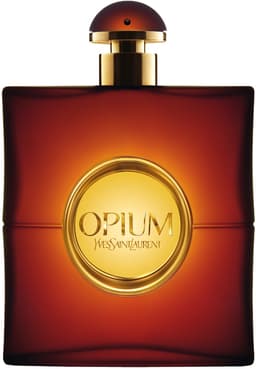
Opium Eau de Toilette, a sulfurously addictive fragrance. Today, the house Yves Saint Laurent is the international leader in luxury fashion. Since 1961, when the designer founded his house, success has never left him, and yet YSL was not the perfect couturier.
Opium by Yves Saint Laurent made its appearance in 1977. Banned in certain countries because of its connotation with an illicit substance, it was literally adored by most women, to the point of quickly selling out. Then, buoyed by its success, it was reinvented as an Eau de Toilette edition, slightly less intense but just as charismatic and unforgettable. Oriental, floral and spicy, Opium Eau de Toilette is a memorable scent, a fragrance of dependence, endowed with an unfailing magnetism. It also comes with a bottle of great beauty. Let us look in more detail at the elements that make up its bottle.
The bottle of Opium Eau de Toilette
Opium Eau de Toilette comes in a bottle that is neither entirely round nor entirely square. In fact, with it, opposing geometric shapes come together to form a single harmony. Indeed, its bottle is made of a thick glass cube, whose sharp edges have been softened into gentle curves. Likewise, to recall this roundness and generosity, a central window opens onto its heart, as if offering a window open onto its fragrance. This is infinitely luminous, yellow in color. Thus, the perfume Opium Eau de Toilette resembles a solar fire burning with new energy. The rest of this bottle, meanwhile, is rather amber. It is brighter and more radiant at its center, darkening toward its edges. On its top, Opium Eau de Toilette bears a golden half-moon-shaped spray nozzle. The names Opium and Yves Saint Laurent, for their part, are inscribed at the center of its window, with lightness and elegance.
A bottle that inevitably evokes Yves Saint Laurent's very first design
In fact, the bottle of Opium Eau de Toilette draws directly on that of the original 1977 Opium. At the time, Yves Saint Laurent chose to draw inspiration from an inro, a small precious case carried by warriors of the Far East, who fastened it to their waist with a small cord. This cord, moreover, was present on the Yves Saint Laurent bottle at the level of its cap. This was formerly less prominent than in its Eau de Toilette edition. It was already a half-moon shape, but a flatter one. Likewise, the orange color was present. However, it leaned more toward a red typical of Chinese customs. Undeniably, Asian tradition was honored. Opium's window, meanwhile, was off-center to the right, while the name of its fragrance appeared in a much larger script. Glass was then entirely absent, in favor of a shell molded from nylon plastic, this material appearing revolutionary at the time. The bottle of Opium Eau de Toilette is thus a perfect blend of tradition and forward-thinking design. It belongs to no era and undeniably possesses a timeless allure.