
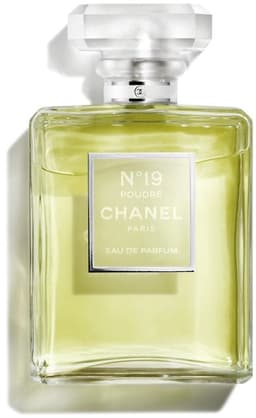
N°19 Eau Poudrée: The Chanel woman, the audacious elegance of noble raw materials from Grasse... At Chanel, one should not think that only N°5 matters! On the contrary, like the luminous and audacious N°19 released in 1970, every number matters and is dressed in elegance for the house created by the sparkling Coco.
Released in 1970, “N°19” is the number of elegance at the heart of the Chanel brand. Faced with this success, Jacques Polge decided in 2011 to revisit it by infusing it with the most powdery elegance in “N°19 Poudré”. As graceful as its predecessor, the fragrance “N°19 Poudré” is here adorned with iris, offering a powdery aspect, but also a musky and silky one. It should be noted that “N°19” is the last fragrance launched during Gabrielle Chanel's lifetime. In her honor, Henri Robert wished to name this fragrance “N°19” in reference to the day of her birth.
Jacques Polge signs a new tribute to Mademoiselle with N°19 Poudré
It was in 1978 that Jacques Polge became the official perfumer of the house of Chanel. He then succeeded Henri Robert, the father of “N°19”. Modest, Jacques Polge does not like people talking about him. With Gabrielle Chanel, he shares a taste for poetry and art and states: A painting, like a fragrance, is a language. A poem in colors and shapes for the former, a poem in scents for the latter... Jacques Polge managed to leave his mark by giving a punch to Chanel's olfactory creations while respecting Mademoiselle's elegance. Today it is his own son, Olivier Polge, who succeeds him as the brand's official perfumer. Jacques Polge is responsible for major successes such as “Allure, 31 rue Cambon” or “Coco” by Chanel.
Pallida iris at the heart of Chanel's N°19 Poudré
A powdery-musky floral, “N°19 Poudré” opens with a combination of neroli and mandarin. The first traces of mandarin appear about 3,000 years ago in the Middle East, mainly in China, where it remains highly popular. Incidentally, mandarin owes its name to its orange color, which echoes that of the silk robes worn by mandarins, the high officials of the Chinese Empire. The first mandarin tree arrived in France in 1800, and gradually the entire Mediterranean began cultivating this small winter fruit. In perfumery, mandarin essence is obtained by cold expression of the fruit's zest. Mandarin gives off tangy, sweet, soft and zesty tones all at once. Then, the heart of “N°19 Poudré” evolves toward ultra-feminine notes, namely those of jasmine, combined with those of Pallida iris. Pallida iris is one of the noblest, but also one of the most expensive ingredients in perfumery. Also known as the blue gold of perfumery, Pallida iris offers powdery and floral scents with slightly musky violet facets. It is the rhizomes of the iris that are used. Unfortunately, its process is long (about 7 years) and delicate, which explains its price. Pallida iris is mainly cultivated in Florence (Italy). The base of “N°19 Poudré” finally meets the softness and creaminess of white musks combined with vetiver and tonka bean.