
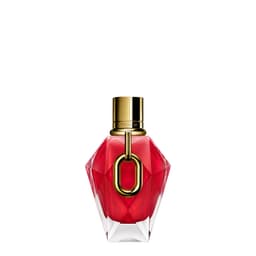
The latest addition to Rabanne's Million line, Million Red for Her is a perfume released in 2026 built on a formula of rare brevity: coconut, ylang-ylang, vanilla. Three raw materials, not one more, for a creamy gourmand sun-kissed scent that fully embraces its sweetness. People either love it or find it overwhelming — it leaves little room for lukewarm reactions.
Three declared notes is few, and it is above all a communication choice. The regulatory list printed on the box suggests a more extensive formula: alongside the expected vanillin, it includes ylang-ylang essential oil, but also bergamot, lavender, coumarin and rose ketones. None of this appears in the official pyramid.
Coconut deserves a closer look, since it does not exist as a raw material in perfumery. There is no coconut essential oil: the smell associated with it is reconstructed from lactones, a family of creamy, fruity molecules also responsible for the velvety quality of peach and apricot. It is an entirely constructed smell, which explains its remarkable consistency from one perfume to another — no one works from a natural, everyone starts from the same building blocks.
Ylang-ylang, on the other hand, is present in its natural form: the label names Cananga odorata, the tree whose flowers are distilled. Distillation proceeds through successive fractions and each yields a different material — the first, called extra, are the most floral and the most expensive; the last, heavier ones, turn woody. This raw material carries a creamy, slightly fruity facet that makes it almost inseparable from coconut in this type of construction.
Vanilla comes through vanillin, its characteristic molecule, declared right after alcohol, the fragrance concentrate and water — the order of a regulatory list follows decreasing quantities, and this one therefore places it very high in the formula. It is a confectionery vanilla rather than a pod vanilla: straightforward, sweet, lacking the leathery, smoky facet that a Bourbon absolute would bring.
The rest works in support without ever drawing attention to itself. A synthetic amber wood provides volume and lasting power without a strongly defined smell of its own. Coumarin brings a cut-hay sweetness that extends the vanilla and rounds it out. Rose ketones slip a fruity inflection beneath the flowers, and bergamot lightens the very first minutes. None of these materials is claimed: they form the binder, not the statement.
What the blend produces is a composition without edges. No sharp break between tiers, no organized contrast: coconut, ylang and vanilla share too many creamy facets to stand clearly apart from one another, and the base materials merely extend this continuity. One can see this as an achievement in legibility or a lack of depth. Both readings hold up, and they fairly clearly separate those who embrace this perfume from those who tire of it.