
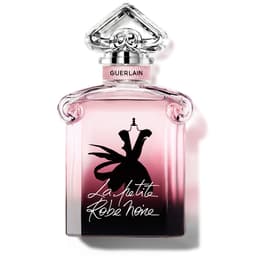
Launched worldwide in 2012, La Petite Robe Noire was not born that year. Delphine Jelk had composed it in 2009 for Guerlain boutiques only, at a time when she did not yet work for the house. Thierry Wasser reworked the formula before its wide release. Built around an accord of black cherry, almond and licorice laid over a rose, the eau de parfum brought the gourmand into Guerlain, and divided critics from its release.
The accord that holds it all together: cherry, almond, licorice
The fragrance is recognized by a cherry. Guerlain names it before all other raw materials and describes it as a black cherry, paired with almond and red fruits. It is this note that gives the sillage its accent.
Auparfum, which smelled the boutique version as early as February 2009, speaks of a bigarreau cherry, figurative and syrupy. The magazine acknowledges that it escapes the worst thanks to its juicy, pulpy, almost mouth-watering character.
Beside it, almond and licorice form the rest of the opening. This combination of lemon, licorice and almond is what Auparfum retains from the first version, and it survived the reworking intact.
The origin of this accord is told by the perfumer herself: a raspberry-morello cherry macaron, paired with a rose, with facets of smoky tea and licorice to give it a less demure edge.
The rose, and the fruit that pulls at it
Guerlain makes the rose the fixed point of the sillage and presents it as the raw material by which the fragrance is recognized. The house describes a deep, faceted rose, obtained by combining an essence with a naturally honeyed Damascena rose absolute.
Raspberry accompanies it, inherited from the original macaron. It pulls the flower toward the red fruit rather than the bouquet, which sets this rose apart from the house's classic roses without stripping it of density.
Licorice runs through the heart and keeps the sugar from turning into confectionery. It is one of the few materials present both in 2009 and in 2012, and it gives the fruit a slightly bitter base.
The base: patchouli and black tea
Patchouli holds the base. It is present enough for Auparfum to place the 2012 version within a fruity-patchouli aesthetic, a phrase that describes an entire family of fragrances from the 2000s.
Smoky black tea closes the composition. It comes directly from Delphine Jelk's original idea, who wanted a dark edge beneath the macaron, and it remains the least sweet material in the fragrance.
These two materials explain why the fragrance does not tip into dessert despite the cherry and almond. They arrive late in the development and give the sillage a duller color than the opening.
What the 2012 reworking shifted
The two versions do not open on the same material. Guerlain now names bergamot in the top. The 2009 review and the perfumer's notes spoke of lemon. The two accounts do not align.
This divergence goes beyond a choice of words. It marks the shift from a boutique exclusive to a widely distributed eau de parfum, whose formula was reworked before being sold everywhere.
Auparfum, in 2012, judges that the new version closely resembles the first and that it has lost some of its singular charm. The house, for its part, presents this work as a return toward the house's style.
One point deserves to be dismissed outright: model No. 2 from 2011, built on iris and orange blossom, left no trace in the formula sold today, which descends from that of 2009.