
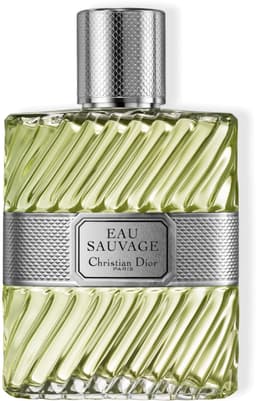
Eau Sauvage is the first men's fragrance by Parfums Christian Dior, composed by Edmond Roudnitska from his laboratory in Cabris and launched in 1966. Its success owes as much to its citrus and aromatic writing as to a then-unprecedented raw material, hedione, of which it constitutes the first major use: a jasmine-like clarity that opens up the composition and brightens the lemon. The consumer tests conducted before its release had nevertheless come back negative.
While the Dior house has drawn a great deal of attention with its Sauvage fragrance in recent years, it should be noted that this fragrance is not the only one to bear such a vivid and striking name. Eau Sauvage came into being long before it and stands as a true legend of masculine perfumery. Created in 1966, this fragrance still continues to inspire imitators across the globe. So how does this perfume manage to cross the decades without ever showing its age? Here is our review on the subject. Let us uncover all its little secrets together!
Olfastory’s review
Dior's Eau Sauvage: why is it such a legend?
To better understand this fragrance's renown, let us look back briefly at its history. Eau Sauvage is the first men's fragrance created by Christian Dior. Highly anticipated, it made an immediate impression upon its release in the 1960s. Ideally designed to accompany elegant men, it is a fresh, seductive fragrance that can be worn perfectly on any occasion. Composed like a vintage, it literally revolutionized masculine perfumery through its rich, complex composition. Before it, fragrances were much simpler. Yet with Eau Sauvage, Dior did not hesitate to pair virility with refinement. Designed in the image of a self-assured man, it is a fragrance synonymous with candor and loyalty, adopted by men for many years.
The many contrasts of Eau Sauvage
If Eau Sauvage still manages to surprise despite its many years of existence, it is because it holds within it a great many facets. Designed with endless contrasts, it proves as raw as it is refined. Avant-garde, it was the very first to use hedione, a synthetic molecule whose scent is reminiscent of jasmine. To this is added the freshness of lemon and bergamot. Petitgrain, for its part, brightens the whole. However, do not be fooled by appearances: this is not an eau de Cologne. It quickly turns more aromatic through contact with lavender, rosemary, basil, coriander, and cumin. Its base, meanwhile, expresses a tenacious, woody virility in a breath of cedar, sandalwood, patchouli, vetiver, and oakmoss. As will be clear, this fragrance does not favor simplicity but offers a multitude of contrasting scents.
A bottle designed like a whisky flask
As for the bottle, Eau Sauvage adopts a thoroughly timeless style. One could almost believe it to be a precious whisky flask straight out of a private club, reserved exclusively for gentlemen. Its oblique fluting gives it movement and a touch of modernity. The whole is also decorated with a scale-patterned label, breaking with its transparent glass, from which emerges a fragrance of an unusual color, somewhere between green and yellow. The whole is topped with a magnetic cap, a small additional detail that only reinforces its luxurious spirit.