
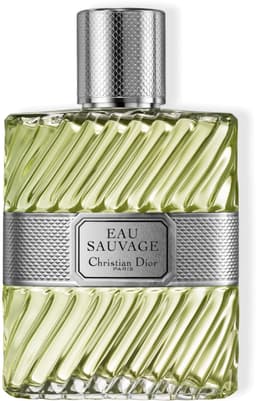
Eau Sauvage is the first men's fragrance by Parfums Christian Dior, composed by Edmond Roudnitska from his laboratory in Cabris and launched in 1966. Its success owes as much to its citrus and aromatic writing as to a then-unprecedented raw material, hedione, of which it constitutes the first major use: a jasmine-like clarity that opens up the composition and brightens the lemon. The consumer tests conducted before its release had nevertheless come back negative.
Eau Sauvage is the name of the very first men's fragrance created by Christian Dior. Born in 1966, this fragrance still continues to win over many devotees across the globe. It must be said that its scent, composed by perfumer Edmond Roudnitska, has not aged a day. Its richness and multiple contrasts give it a unique personality, one that never grows tiresome to rediscover. However, no great fragrance would be complete without a bottle worthy of its renown. So let us take a closer look at how the bottle of the iconic Eau Sauvage came to be.
Eau Sauvage, a bottle designed like a whisky flask
For many men, Eau Sauvage was their very first fragrance. Indeed, before it, most of them made do with a simple eau de Cologne to finish their grooming routine. Thus, to capture their attention, a fragrance needed to be presented in a bottle with a familiar resonance for all. Christian Dior had the idea of reinterpreting one of the objects most associated with masculinity at the time: a whisky flask. Easy to hold, this bottle could almost seem to have come straight out of a private club, reserved exclusively for gentlemen. Classic and timeless, it draws on a shape known to all, embraced by many generations. Thus, with such a visual, Eau Sauvage immediately gained a universal appeal.
A timeless bottle full of details
While Dior is now famous for its consistently pared-down designs and its unadorned elegance, the Eau Sauvage bottle is undoubtedly one of the most detailed. Its glass is finely sculpted with multiple oblique flutes. These represent a genuine technical feat and give the visual greater modernity. From the outset, they convey a sense of perpetual movement. Moreover, despite the fragrance's great age, they have never been altered since its creation. These flutes are etched onto a fully transparent and finely frosted glass, allowing a glimpse of a fragrance with an unusual color, between yellow and green. Here too, this hue was not chosen at random. It evokes freshness and vitality, echoing all the aromatic and citrus elements present in Eau Sauvage.
Finally, a gray label encircles the whole. Covered with a trompe-l'oeil pattern resembling scales, it also evokes the surface of a man's signet ring. This decoration is also carried over onto the fragrance's cap. One last detail worth noting: the cap of Eau Sauvage is now magnetic. While it was not so at the fragrance's launch, this only heightens the luxurious feel of the fragrance. Undeniably, from its launch, Eau Sauvage was designed to make its mark on history and win over every generation of men.
As a reminder, this bottle comes in three different sizes: 50, 100, or even 200 ml.