
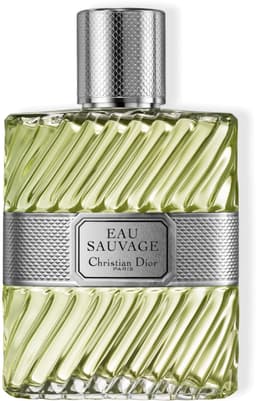
Eau Sauvage is the first men's fragrance by Parfums Christian Dior, composed by Edmond Roudnitska from his laboratory in Cabris and launched in 1966. Its success owes as much to its citrus and aromatic writing as to a then-unprecedented raw material, hedione, of which it constitutes the first major use: a jasmine-like clarity that opens up the composition and brightens the lemon. The consumer tests conducted before its release had nevertheless come back negative.
Eau Sauvage was released in 1966. It is the first men's fragrance by Parfums Christian Dior, and Edmond Roudnitska composed it from Cabris, a village in the Grasse hinterland where he ran his own laboratory, Art et Parfum. He worked there away from the industrial houses, taking whatever time he judged necessary. The bottle was designed by Pierre Camin.
Roudnitska was not a house perfumer. He had founded his own company in 1946 and argued, in the books he wrote, that the perfumer belongs among artists in the same way as the musician or the painter. Dior had long been familiar with his work: Diorama, Eau Fraîche, and Diorissimo in 1956 were already his creations; Diorella would follow in 1972.
Hedione, a material derived from jasmine
The story of this material begins in 1957, when chemist Edouard Demole studied the microcomponents of jasmine concrete at Firmenich, whose analysis had remained incomplete. His work led to the discovery of methyl dihydrojasmonate, patented in the early 1960s under the name hedione, from the Greek hedone, meaning pleasure.
What hedione brings to Eau Sauvage is not a jasmine scent, but space. It brightens the citrus, the lemon in particular, and gives the other materials room to breathe. Where perfumery of that era piled up dense materials, the writing here becomes airy and transparent. Eau Sauvage is the first commercial success built on this material, and its use opened a path that perfumery has never left since: hedione is now found in a large proportion of fragrances produced, both masculine and feminine.
Vetiver and oakmoss beneath the citrus
The top rests on lemon and bergamot, heightened by lavender and rosemary, two garrigue aromatics. Hedione forms the heart and gives it a jasmine-like clarity that never tips fully into the floral. The base returns to vetiver and oakmoss, whose woody, slightly bitter foundation anchors the structure. The balance relies on very few materials, and Roudnitska claimed this economy of means as a virtue: a simple composition, achieved through successive removal rather than accumulation.
A launch decided against the test results
Before 1966, men had few fragrances designed specifically for them and relied mostly on eaux de Cologne. Roudnitska's fragrance failed to convince the consumers surveyed before its release: the tests came back negative, yet the house launched it anyway. Eau Sauvage nevertheless prevailed, and still remains in Dior's catalog more than half a century after its creation.