
Dolce & Gabbana
Pour Femme
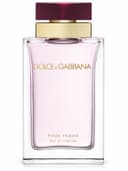
The first fragrance from Dolce & Gabbana, launched in 1992 and composed by Jean-Pierre Mary, Pour Femme changed formula in 2012. The eau de parfum sold today, which the house describes as floral and amber, brings together neroli, raspberry, and green mandarin, jasmine and orange blossom, over a base of marshmallow, vanilla, heliotrope, and sandalwood.
- Brand
- Dolce & Gabbana
- Launch year
- 1992
- Perfumer
- Jean-Pierre Mary
- Gender
- Unisex
- Olfactory family
- Floral
- Secondary family
- Oriental
- Concentration
- Eau de Parfum
- EAN
- 3423473020653 (50 ml) · 8057971180400 (100 ml)
Published · Updated
Share
Where to buy
Links to our partner shops.
Pour Femme is the first fragrance from Dolce & Gabbana. It was born in 1992, when Domenico Dolce and Stefano Gabbana were already dressing a woman of southern Italy, Sicilian above all. It first bore only the label’s name; the name Pour Femme took hold with the 2012 formula.
Jean-Pierre Mary and Martine Pallix
Jean-Pierre Mary composed the 1992 fragrance. Elena Vosnaki of Perfume Shrine and Victoria Frolova of Bois de Jasmin pair him with Martine Pallix, and Elena Vosnaki places both perfumers at IFF. Victoria Frolova sees in it a glamorous aldehydic floral, still marked by the 1980s.
Elena Vosnaki recounts a studio legend: the two designers supposedly threw the trial versions against the wall of their studio to judge the effect, and cried victory when two of them matched. She files this story among the strokes of genius the industry likes to tell.
Sicily, from Tornatore to Testino
Advertising anchors the fragrance in Sicily, Domenico Dolce’s native land. In 1994, Giuseppe Tornatore filmed Monica Bellucci there in black and white, to music by Ennio Morricone; in 2012, Mario Testino shot Laetitia Casta and Noah Mills there, in the light of a village wedding.
2012: a revised formula
In 2012, the house relaunched its first two fragrances, the 1992 feminine and its masculine counterpart, Pour Homme. It spoke of a simple fine-tuning; Angela of Now Smell This and Thomas Dunckley of The Candy Perfume Boy nonetheless found an entirely new composition, fruity and sweet.
The new eau de parfum came out in the fall of 2012 in 50 and 100 ml bottles, accompanied by a body emulsion and a shower gel. The bottle grew slimmer, and the pink juice took on a darker cap than the bright red of the original.
The house’s message
At the relaunch, the house described the Dolce & Gabbana woman as passionate, sensual, and maternal, born of a Mediterranean made of harmonies and contrasts. It claimed to seek a synthesis between its love of tradition and a desire for the contemporary.
Today the house presents the eau de parfum as the embodiment of the Mediterranean woman, passionate and sensual. It classes it among floral and amber notes and attributes its charm to the balance of green mandarin, orange blossom, and marshmallow.
Olfactory pyramid
- Top notesThe first minutes
- Heart notesThe heart of the perfume
- Base notesWhat lingers
Share your impressions
Create an account to keep your votes and find your notebook.
The advertising
Tornatore in 1994, Testino in 2012
In 1994, Giuseppe Tornatore filmed Monica Bellucci on a Sicilian coast; in 2012, Mario Testino shot Laetitia Casta and Noah Mills there.
In 1994, Giuseppe Tornatore directed a black-and-white film for the house’s first feminine fragrance, on a rocky Sicilian coast on a scorching summer day. Ennio Morricone wrote the music, and Monica Bellucci played the lead role.
A young man beats an octopus against the rocks. Behind a white sheet held by two women, Monica Bellucci slips into a swimsuit and leaves her bra behind; the young man picks it up to breathe in its scent. In 2024, Libero Quotidiano recalled the protests the octopus scene provoked.
In 2012, Mario Testino filmed Laetitia Casta and Noah Mills, the face of Pour Homme, in black and white, between the village of Erice and a beach in the Zingaro reserve. In a black dress, Laetitia Casta leaves a wedding on the village square to join her lover in a convertible.
More perfumes from Dolce & Gabbana
Similar perfumes
Similar notes and family, from other houses.
- Love Don’t Be Shy Eau FraîcheBy Kilian
- Mademoiselle GuerlainGuerlain
- Quatre en RougeBoucheron
- Born in Roma Donna Rendez-vous IvoryValentino
- Love Story Eau SensuelleChloé
- Bonbon Pink BowViktor & Rolf
- Bonbon HolidayViktor & Rolf
- Dylan Blush PinkVersace