
Christian Dior
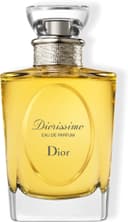
Diorissimo
The Diorissimo feminine fragrance by Dior The house of Dior is without question one of the most luxurious names on the planet. What is more, it has no equal when it comes to enhancing femininity.
- Brand
- Christian Dior
- Launch year
- 1956
- Perfumer
- Gender
- Women
- Olfactory family
- Floral
- Concentration
- Eau de Parfum
Where to buy
Blending elegance and refinement, its fragrances are timeless classics that one never tires of rediscovering. Designed to transcend the ages, they reveal to us a radiant, graceful, and majestic femininity. Diorissimo has been part of the Dior catalog since 1956. A testament to an era and an infinitely floral and romantic fragrance, it has come down to us without ever aging, to our great delight.
Diorissimo, a fragrance synonymous with calm
Diorissimo is an Eau de Toilette that made its appearance in the Paris of the 1950s. At that time, every Christian Dior collection was highly anticipated. The designer graced the covers of the world's greatest magazines. Christian Dior was already perceived as a true star in his field. Yet, as if to escape this frenzy, he loved retreating to his country house, where he took pleasure in gardening. He confided that spring was his favorite season. The arrival of lily of the valley was, for him, a true windfall that he would not have missed for anything in the world. Christian Dior made lily of the valley “his” flower. Endearing, frail, and candid, it fascinated him with its infinity of small bells. Every spring, it would revive in him an intact emotion. Drawing inspiration from this soft, immaculate flower, Christian Dior decided to turn it into a fragrance. Embodying feminine grace and tenderness, Diorissimo made its appearance in 1956.
Diorissimo, a floral and luminous composition
Diorissimo is a fragrance akin to a lily of the valley soliflore. As such, this is its main ingredient. Entirely at odds with the trends of its time, Diorissimo relies on delicacy. Yet in the 1950s, perfumers favored rather powerful notes. Diorissimo is the very embodiment of a return to nature. It should be noted, however, that lily of the valley loses all its scent once distilled. As a result, its natural odor had to be entirely recomposed in the laboratory. Diorissimo is therefore a testament to all of the house of Dior's expertise. Lily of the valley is here enhanced by a blend of rose, lilac, jasmine, lily, and ylang-ylang. What remains in its sillage is a radiant, springlike scent. Sandalwood and rosewood reinforce the sensuality of the whole. A few green notes are also added here and there to amplify its freshness.
The timeless bottle of Diorissimo
Diorissimo comes to us in a bottle beyond time. However, it should be noted that this is not its original bottle. Initially, Diorissimo was presented in a Baccarat crystal flacon, resembling a hand-carved amphora. It was decorated with beads from which sprang a bouquet of springtime flowers in bronze. This time, its style is softer, but its signature is no less luxurious.
Olfactory pyramid
- Top notesThe first minutes
- Heart notesThe heart of the perfume
- Base notesWhat lingers
Share your impressions
Create an account to keep your votes and find your notebook.
The advertising
René Gruau's line, 1956-1979
Dated 1956 by the house, René Gruau's illustration shows a woman seen from behind holding a bouquet of lily of the valley; its advertisements ran until 1979.
The house's official chronology dates a René Gruau advertising illustration for Diorissimo to 1956. Osmoz describes the image: a woman seen from behind, holding a bouquet of lily of the valley. The exhibition Dior Illustrated: René Gruau and the Line of Beauty, held in London in 2010, reports that the original 1956 drawing showed the woman nude and that Dior asked Gruau to dress her in a black sheath; the originals on display were done in ink, gouache, and pencil.
Gruau's line accompanied the fragrance well beyond its launch. A catalog of vintage advertisements lists insertions from 1961 and 1968 grouping Miss Dior, Diorama, and Diorissimo, a 1963 advertisement titled “The Ultimate Summer Fragrance,” and a placement still running in 1979. A gallery links this series to a broader body of work: the illustrator had already signed the campaign for Miss Dior, the house's first fragrance, before those for Diorama, Diorissimo, and Eau Sauvage.